Pilgrimage With Swami Narasiṅgha – Part 1 Imlitalā
Pilgrimage With Swami Narasiṅgha – Part 1: Imlitalā
This is the first part in a series of articles for Krishna Talk where Śrīla B.G. Narasiṅgha Mahārāja talks about various holy places. Our first article begins with the pastimes and philosophical significance of Imlitalā. This article was adapted from a number of talks that Mahārāja gave in the 1990s.
Articles in this series:
Pilgrimage With Swami Narasiṅgha – Part 1: Imlitalā Pilgrimage With Swami Narasiṅgha – Part 2: Śrī Śrī Rādhā-Dāmodara Temple Pilgrimage With Swami Narasiṅgha – Part 3: Śrī Śrī Rādhā-Govinda Mandira Pilgrimage With Swami Narasiṅgha – Part 4: Kurukṣetra Pilgrimage With Swami Narasiṅgha – Part 5: Śrī Śrī Rādhā-Ramaṇa Temple Pilgrimage With Swami Narasiṅgha – Part 6: Śrī Śrī Rādhā-Madana-mohana Temple Pilgrimage with Swami Narasiṅgha – Part 7: Keśī Ghāṭa Pilgrimage with Swami Narasiṅgha – Part 8: Govardhana Pilgrimage with Swami Narasiṅgha – Part 9: Rādhā-kuṇḍa & Śyāma-kuṇḍa Pilgrimage with Swami Narasiṅgha – Part 10: Kāliya Ghāṭa
I remember a time in Vṛndāvana during the 1980’s when the streets would be empty by 5:00 in the evening, even during Kārttika. At that time, I had a good chance to do parikramā of many places. Nowadays it is super crowded, so I sit in in my room and do parikramā on my beads, and I only go to Govardhana now and then. When I first came and lived in Vṛndāvana, I stayed in Sevā-kuñja. Sevā-kuñja is a large area and within that there are many temples such as Rādhā-Dāmodara, Rādhā-Śyāmasundara, and it even includes Loi Bazaar and beyond. Sevā-kuñja is also known as the rāsa-sthālī because it is the place of the* rāsa-līlā*.
I was staying near Nidhivana which is where Rādhā and Kṛṣṇa rest during the rasa dance. Nobody is allowed in Nidhivana at night. The local vraja-vāsīs claim that even the monkeys leave and if you look into the area of Nidhivana at night, you will go mad. But my room was overlooking that whole area and at night I would sometimes sit on the balcony and chant, looking over Nidhivana. I didn’t go mad, although some may disagree! The trees in that area are of an unusual shape. It is mentioned that when Kṛṣṇa walked into the forest, all the trees bowed down to Him and they stayed like that.
There are many trees all over Vṛndāvana, but in Nidhivana, all the trees are very peculiar – they are all bowing down. Even the descendants of those trees, the new trees, grow like that. Nowadays, if you go on top of a building in Vṛndāvana and look around, there’s almost no trees in Sevā-kuñja, but in the time of Mahāprabhu it was a forest with many big trees.
When Jīva Gosvāmī saw that people were coming to Vṛndāvana and things were being built, he took permission from Emperor Akbar and constructed a wall around Sevā-kuñja so no one could live there. At a certain place, if you go on the roofs of any the buildings in Sevā-kuñja, you can see the original wall, and you’ll also see that there is another wall going right through the middle of Sevā-kuñja. One side is called Sevā-kuñja and the other side is called Kiśora-vana. A hundred and fifty years ago, there was a quarrel and a wall was built through Sevā-kuñja, then people started living there. Another party made an entrance from the other side, and they called that Kiśora-vana.
So many people are living in Kiśora-vana, and that is where I stayed when I came to live in Vṛndāvana. Actually, I only stayed there for two nights due to force of circumstances. During that time, I could only think of Śrīla Prabhupāda and Śrīla Śrīdhara Mahārāja, and I had a constant prayer in my mind – “Please take me out of this place! Give me a suitable place in Vṛndāvana.” Who is fit to live in Sevā-kuñja? It is such a sacred place. What to speak of live there, who is even fit to do bhajana in that place?
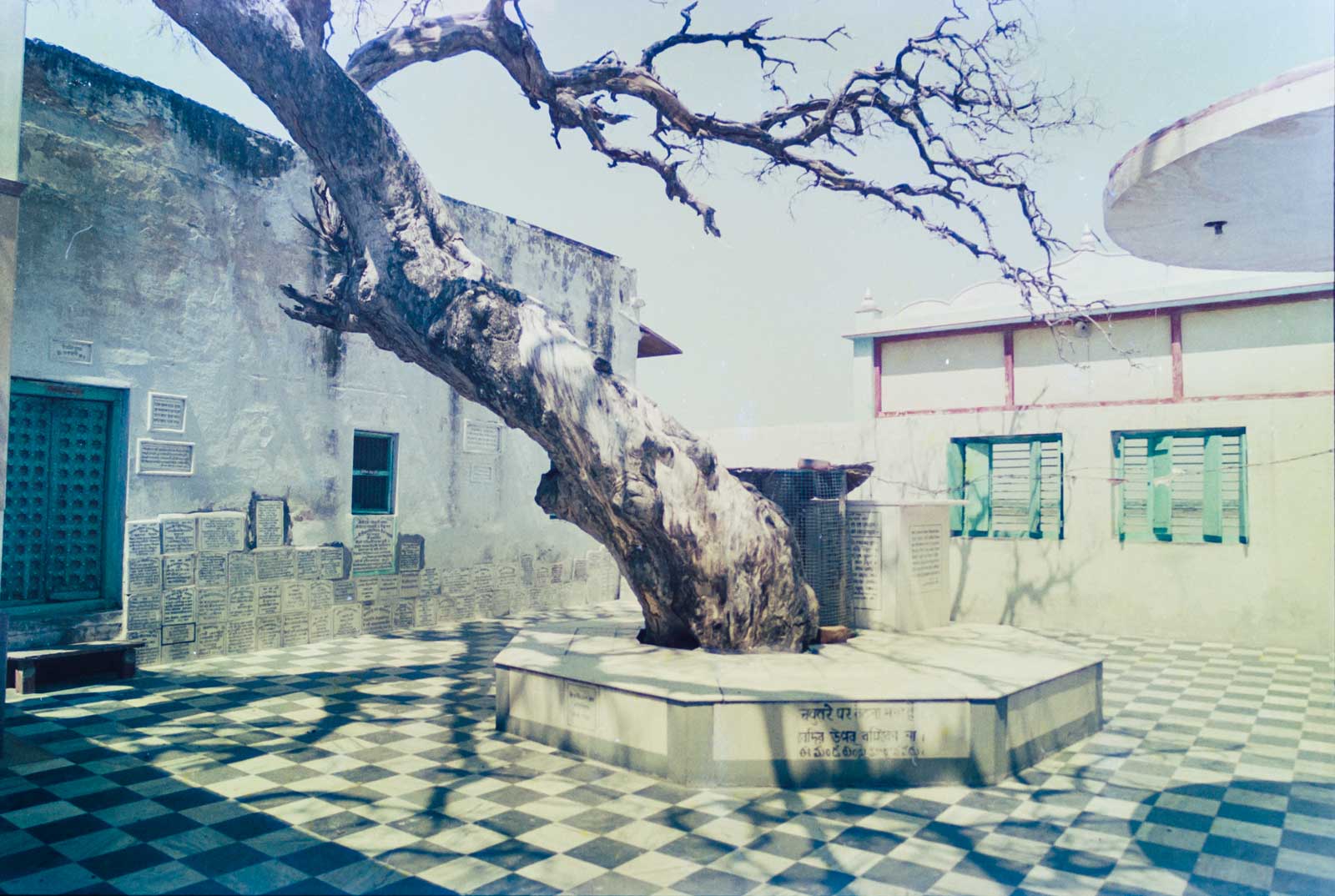
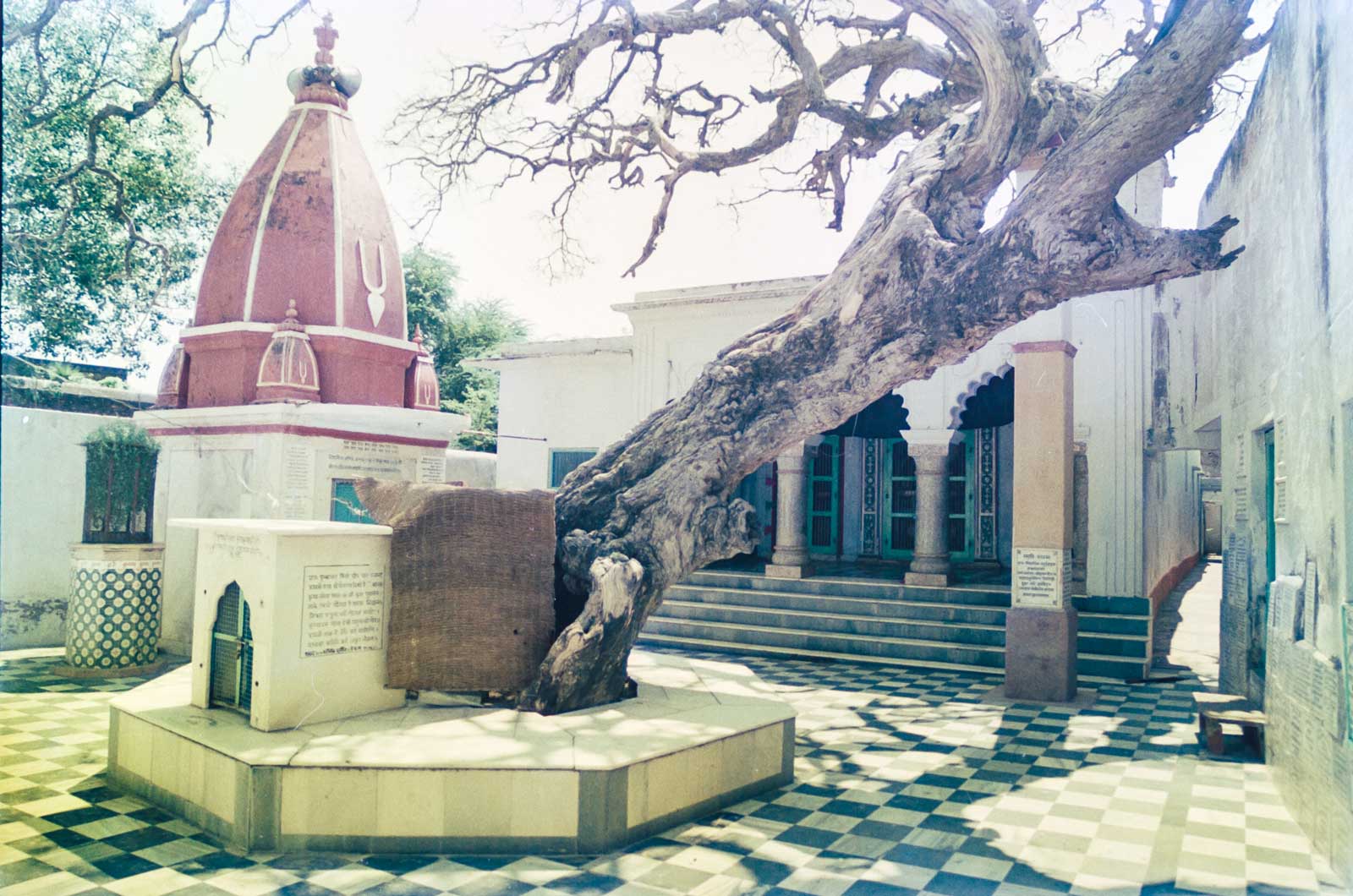
There is a place in Sevā-kuñja known as Imlitalā. Imlitalā means ‘tamarind tree.’ A few years ago, what they claimed to be the original tree passed away. Some say that the original tree was five-thousand years old. Whatever the case, it was a very old tree. So many external explanations can be ascribed to the tree’s disappearance, but if we are thinking that the fault lies with lack of irrigation, improper rains etc, then these kinds of explanations will make us dry. We must look at the substance of the matter. Ultimately, everything in Vṛndāvana is personal, conscious, and by their own sweet will, and by Kṛṣṇa’s will, they manifest and unmanifest.
What is the importance of Imlitalā? As I mentioned before, Sevā-kuñja is the place of rāsa-līlā. Actually, Kṛṣṇa has many rāsa-līlās in many places, such as the rāsa-līlā at Govardhana. Then there is the rasa dance at Rādhā-kuṇḍa. That is only by special invitation. That is for a very small exclusive group. But in Vṛndāvana forest, at Sevā-kuñja, the general call to all those in mādhurya-rasa came out and it had a purpose. Of course, the main purpose is that everything is for Kṛṣṇa’s pleasure, but the central purpose of this particular rasa was to call the entire mādhurya section together to settle a dispute. Kṛṣṇa wanted to show who is most dear to Him. That was the real purpose of this rāsa-līlā.
So, during His pastimes in the Vṛndāvana arena of the rāsa–līlā, Kṛṣṇa was there with millions and millions of gopīs and He expanded Himself with each and every one of them individually. Rādhārāṇī was also present. If you have a hundred million gopīs, or even six hundred billion gopīs, all of them together cannot equal the potency of Śrīmatī Rādhārāṇī. Most of the gopīs are Rādhārāṇī’s expansions, such as the *aṣṭa-sakhīs, *and even Candrāvalī. She is the source of them all, just as Kṛṣṇa is the avatārī, the source of all avatāras. But are all these avatāras equal to Kṛṣṇa, or is He superior? Similarly, Rādhārāṇī is the *hlādini-śakti, *the source of all pleasure for Kṛṣṇa. She is His pleasure potency personified. Anything that pleases Kṛṣṇa can only be by Her potency, by Her extended energy. This is the topmost secret.
But during the rasa dance, Rādhārāṇī saw that Kṛṣṇa was being equal to everyone and She became angry about this. She was thinking, “I am being treated as an equal? How is He showing any equality here when I am infinitely more than them?” Then a peculiar thing happened which shows the superiority of Rādhārāṇī in relation to all other devotees of Kṛṣṇa as His supreme pleasure potency, and during this incident Kṛṣṇa Himself showed a special devotion and attraction to Her.
In order to prove Her potency during the rāsa-līla, first She danced in such a way that the whole arena became captivated. Then She suddenly left and when She did so, the whole rasa dance dried up like a rose in the desert. Kṛṣṇa continued to perform the rasa dance for a moment and suddenly He realised there was no rasa! As soon as Rādhārāṇī left the rasa dance, Kṛṣṇa no longer felt any pleasure, even while dancing with a multitude of gopīs. Kṛṣṇa then left the rāsa-līlā in search of Śrī Rādhā.
Kṛṣṇa didn’t leave the rasa dance first – that is not possible when Rādhārāṇī Herself is dancing there. But because Kṛṣṇa was sharing Himself equally with so many gopīs, Rādhārāṇī took exception to this and She left. Rādhārāṇī’s leaving the rasa dance is not directly mentioned in the *Śrīmad Bhāgavatam – *it is not exactly clear what happened. Why does Kṛṣṇa suddenly leave the rasa dance? Of course, He is independent, He is an autocrat, but it follows something. It is mentioned in detail within the writings of the Gosvāmīs and other previous ācāryas. Their understanding is that it is not possible that Kṛṣṇa would simply leave – something must have occurred prior to that.
There is a small, narrow road leading to Imlitalā. It doesn’t have a sign, but in the Vṛndāvana municipality records, it has a name. It is called Māna Gali – gali means road and māna means anger. That is the ‘street of anger.’ This is the route that Rādhārāṇī took when She was displaying Her transcendental mood of anger.
Finally, Kṛṣṇa found Rādhārāṇī and after being reunited, the Divine Couple sat together under a tamarind tree on the banks of the Yamunā and there, during Their loving embrace, Rasa-rāja Kṛṣṇa and Mahā-bhāva Rādhārāṇī became one.
When Mahāprabhu visited Vṛndāvana, about 4,500 years later, every day He would walk from Akrura Ghāṭa to Imlitalā and sit under the tamarind tree and chant, meditating upon Rādhā-Govinda’s pastimes. But this is not just a place where Mahāprabhu came and sat, reminiscing about His past as Kṛṣṇa. He didn’t return to that place just because there was a nice big tree that gave some shade and there was a good view of the Yamunā. Mahāprabhu is Rādhā and Kṛṣṇa combined – so when did They combine? When in eternity, in līlā, did that happen? The meeting of the Divine Couple at Imlitalā is the place and time where it happened. When Rādhā and Kṛṣṇa combine, that is called *vipralambha-sambhoga, *union in separation. That form is Mahāprabhu. His coming to Imlitalā is His returning to the womb of His conception where Rādhā and Kṛṣṇa became one. In terms of gaura–*lilā, *the birthplace of Mahāprabhu is at the Yogapītha in Māyāpura-Navadvīpa, but Imlitalā is where the conception of Mahāprabhu was born. Therefore, Śrī Caitanya Mahāprabhu resides eternally at Imlitalā.
Centuries later, a small temple was built at Imlitalā which was under the management of the gosvāmīs of Rādhā-Madana Mohana Temple. I heard a story that once, one of the branches of the tree was hanging over the property next to Imlitalā, so the caretaker of that land tried to cut the branch and it began to drip blood. That land belonged to a queen and repenting her actions, she arranged for so many sevās at Imlitalā.
During the time of Śrīla Bhaktisiddhānta Sarasvatī Ṭhākura, the Gauḍīya Maṭha organised Vraja-maṇḍala parikramā and Sarasvatī Ṭhākura saw how Imlitalā had become run down and neglected. Everyone had practically forgotten about it. He tried to negotiate with the Madana Mohana gosvāmīs to purchase the land, but they refused. Sarasvatī Ṭhākura understood the importance of Imlitalā to the Gauḍīya Vaiṣṇavas and stated, “I eternally reside at Imlitalā.”
It was only after the time of Sarasvatī Ṭhākura that his disciple, Śrīla Bhakti Sāraṅga Gosvāmī Mahārāja managed to purchase Imlitalā. He was from a very high class Bengali brāhmaṇa family and a gosvāmī in the nityānanda-vaṁśa, so everyone in Vṛndāvana respected him. He eventually purchased the land with the help of a rich godbrother named Sakhī Caraṇa Prabhu. When Gosvāmī Mahārāja established a beautiful temple at Imlitalā, Śrīla Śrīdhara Mahārāja composed some Sanskrit verses glorifying Imlitalā and praising Sarasvatī Ṭhākura, Sāraṅga Gosvāmī and Sakhī Caraṇa. These verses are still there at the temple carved in marble on the wall.*
(Narasiṅgha Mahārāja looking at the inscribed verses by Śrīla Śrīdhara Mahārāja in 1994.)
Later, when Śrīla Śrīdhara Mahārāja wrote his Prema-dhāma-deva Stotram, he composed this verse about the importance of Imlitalā:
*tintiḍī-talastha-yāmunormi-bhāvanāplutaṁ
nirjanaika-rādhikātma-bhāva-vaibhavāvṛtam
śyāma-rādhikāpta-gaura-tattva-bhittikākaraṁ
prema-dhāma-devam eva naumi gaura-sundaram*
“I offer my obeisance unto Śrī Gaurasundara, that Divine Personality who is the abode of pure prema. While sitting under a tamarind tree, the waves of the Yamunā reminded the Lord of Kṛṣṇa’s water pastimes with the gōpīs. Alone in that secluded place, Mahāprabhu’s entire being was pervaded with thoughts of Rādhikā’s glories. It was here that Śyāmasundara took the mood of Rādhikā and the separate gaura-tattva became manifest.” (Prema-Dhāma-Deva Stotram 42)
I would venture to say that most devotees have not understood the importance of Imlitalā unless they have gleaned it from this verse by Śrīla Śrīdhara Mahārāja, or heard it from a few persons in the Gauḍīya Maṭha. This verse is probably the only place in the English language, or possibly in any language, where the importance of Imlitalā has been asserted.
At one time, Śrīla Śrīdhara Mahārāja mentioned that in Vṛndāvana two places are most important – Rādhā-Dāmodara Temple and Imlitalā. In other words, you actually only have to go to these two places. If you only go to these two places when you visit Vṛndāvana, then everything is complete. You don’t have to go Govardhana Hill, Varṣāṇā, or the Janmasthāna in Mathurā. If you go to these two places then your parikramā is successful.
*** Footnote:** The Sanskrit ślokas composed by Śrīla Śrīdhara Mahārāja that are at Imlitalā are as follows:
*kālindī puline’bdhi dṛg-yuga-vidhau śāke’ha vṛndāvana
**ekānte nija-nāma-kīrtana rasāsvādaika moda kṛteḥ
**śrī-caitanya-mahāprabhoḥ pada-yugaṁ saṁpūjitaṁ saṁvabhau
*kṛṣṇa krīḍana-tintiḍī taru-tale śrī-kṛṣṇa dāsādibhiḥ
On the banks of the River Kālindī in Vṛndāvana, He felt great delight in exclusively relishing the kīrtana-rasa of His own Names. Śrī Caitanya Mahāprabhu’s worshipable lotus feet appeared under this tamarind tree, the place of Śrī Kṛṣṇa’s playful pastimes with His servants and other associates, in 1437 of the Śakābda Era (1524 CE)
*gauḍa gaṅgā-taṭe vrajābhida navadvīpe hi māyāpure
**śrī-caitanya-maṭha-prakāśaka jagajjīvaika kalyāṇa-kṛt
**śrī-siddhānta-sarasvatīti vidito gauḍīya gurvanvaye
*bhāto bhānuriva prabhāta-gagane rūpānugaiḥ pūjitaḥ
That personality who resides in Bengal on the banks of the Gaṅgā at Māyāpura within Navadvīpa which is considered to be Vraja, has manifested Śrī Caitanya Maṭha for the welfare of the jīvas of this world. He is known as Śrī Siddhānta Sarasvatī in the succession of Gauḍīya gurus. Splendorous as the sun in the morning sky, he is worshiped by the followers of Śrī Rūpa Gosvāmī.
*tacchiṣyau guru-gaura-sevana mahotsāhanvitaḥ śrīyuto
**nityānanda śubhanvayaḥ suviditaḥ śrī-bhakti-sāraṅgakaḥ
**sthānasyāsya su-sajjanābhilaṣitaṁ sevādhikāraṁ śubham
*gaurābde’labhatācale suyugame māse tu dāmodare
His disciple, who possesses great enthusiasm for the service of Śrī Śrī Guru-Gaurāṅga, is in the grand succession of Nityānanda Prabhu and is known as Śrī Bhakti Sāraṅga. He took on the auspicious service of this place which was the desire of the devotees, during the month of Dāmodara in Gaurābda 452 (1938 CE).
*śrī-siddhānta-sarasvatī prabhupādābhīṣṭasya saṁpūrakaḥ
**śrī-māyāpura-gaura-janma bhūvi yaḥ śrī-mandiraṁ nirmamau
**sa śrīman vidītaś ca bhakti-vijayo ratne suvedānvite
*gaurābde kurute sakhī-caraṇakaḥ saṁskāra-sevām iha
He who fulfilled the desire of Śrī Siddhānta Sarasvatī Prabhupāda by building a sacred temple at Gaura’s birthplace in Śrī Māyāpura, who is known as Sakhī-caraṇa Bhakti Vijaya, undertook the service of renovating this temple in Gaurābda 459 (1945 CE).
Related Articles and Books
📚Pilgrimage With Swami Narasiṅgha Series Index 📚 Prema Dhāma Deva Stotram with the Narasiṅgha Sevaka Commentary Series Index 📖 In Search of the Ultimate Goal of Life by Śrīla A.C. Bhaktivedānta Swami Prabhupāda 📖 Śrī Dāmodara Kathā by Śrīla Bhakti Gaurava Narasiṅgha Mahārāja 📖 Prabhupāda Vijaya by Śrīla Bhakti Gaurava Narasiṅgha Mahārāja The Ontological Position of Śrī Śrī Rādhā-Govinda by Śrīla B.R. Śrīdhara Deva Gosvāmī Śrī Govardhana Pūjā by Śrīla Bhakti Rakṣaka Śrīdhara Deva Gosvāmī The Vṛndāvana Express and the Navadvīpa Special by Śrīla Bhakti Rakṣaka Śrīdhara Deva Gosvāmī Vraja Bhāva by Śrīla Bhakti Gaurava Narasiṅgha Mahārāja The Worship of Govardhana by Śrīla Bhakti Gaurava Narasiṅgha Mahārāja Dāsa Gosvāmī and the Unique Position of Govardhana by Śrīla Bhakti Gaurava Narasiṅgha Mahārāja Ācāryas at Śrī Śrī Rādhā-Dāmodara Temple, Vṛndāvana by Śrīla Bhakti Gaurava Narasiṅgha Mahārāja Pilgrimage to Vṛndāvana-dhāma by Śrīla Bhakti Gaurava Narasiṅgha Mahārāja The Appearance of Rādhā-kuṇḍa by Śrīla Bhakti Gaurava Narasiṅgha Mahārāja
Further Reading
Rādhā-kuṇḍa and Śyāma-kuṇḍa by Śrīla Bhaktivinoda Ṭhākura Śrī Śrī Raghunātha Dāsa Gosvāmī by Śrīla Bhaktivinoda Ṭhākura Vṛndāvana by Śrīla Bhaktivinoda Ṭhākura