Pilgrimage with Swami Narasiṅgha – Part 10 Kāliya Ghāṭa
Pilgrimage with Swami Narasiṅgha – Part 10: Kāliya Ghāṭa
In our tenth instalment of ‘Pilgrimage with Swami Narasiṅgha,’ Mahārāja takes us to Kāliya Ghāṭa in Vṛndāvana, where Kṛṣna subdued the serpent, Kāliya, and explains the significance of this pastime. This article is based on a series of classes by Śrīla Narasiṅgha Mahārāja given in South India in February 2006, and Śrī Vṛndāvana-dhāma in November 1994.
Articles in this series:
Pilgrimage With Swami Narasiṅgha – Part 1: Imlitalā Pilgrimage With Swami Narasiṅgha – Part 2: Śrī Śrī Rādhā-Dāmodara Temple Pilgrimage With Swami Narasiṅgha – Part 3: Śrī Śrī Rādhā-Govinda Mandira Pilgrimage With Swami Narasiṅgha – Part 4: Kurukṣetra Pilgrimage With Swami Narasiṅgha – Part 5: Śrī Śrī Rādhā-Ramaṇa Temple Pilgrimage With Swami Narasiṅgha – Part 6: Śrī Śrī Rādhā-Madana-mohana Temple Pilgrimage with Swami Narasiṅgha – Part 7: Keśī Ghāṭa Pilgrimage with Swami Narasiṅgha – Part 8: Govardhana Pilgrimage with Swami Narasiṅgha – Part 9: Rādhā-kuṇḍa & Śyāma-kuṇḍa Pilgrimage with Swami Narasiṅgha – Part 10: Kāliya Ghāṭa
On the parikramā-mārga in Vṛndāvana, there is a small ghāṭa called Kāliya Ghāṭa which is very easy to miss if you don’t know what you are looking for. It is not a big ghāṭa like Keśi Ghāṭa and it only has a few maṇḍapas. That is the place where Kṛṣṇa defeated the Kāliya serpent.
Why Kāliya Came to Vṛndāvana
(Statues of Kṛṣṇa, Kaliya and the Nāgapatnīs)

Originally, Kāliya was living in a place called Ramaṇaka Island, which was the abode of the serpents. Some people say that island is modern day Fiji. So why did Kāliya come all the way to Vṛndāvana? It is said that every month, the snakes on Ramaṇaka Island would make a peace offering to Garuḍa so that he wouldn’t eat them. In his commentary, Viśvanātha Cakravartī Ṭhākura says:
Once in every fifteen days the snakes used to individually offer Garuḍa specially prepared fruits under a tree so that so he would not eat them and to ensure their protection. Although all the serpents were dutifully making offerings to Garuḍa, one serpent, the arrogant Kāliya, son of Kadru, would eat all these offerings before Garuḍa could claim them. Thus, Kāliya directly defied the carrier of Lord Viṣṇu. The great and powerful Garuḍa, who is very dear to the Supreme Lord, became angry when he heard of this. Desiring to kill Kāliya, he rushed to this serpent with tremendous speed.
Because Kāliya had stolen Garuḍa’s offerings, Garuḍa began beating him, and he fled and took shelter of a lake, which was on the side of the Yamunā River. This was because he had heard that Garuḍa could not enter that lake, and there was a reason for that. Previously, the sage, Saubhari Muni was doing meditation underwater in that lake, and Garuḍa used to come there and eat the fish. Seeing the distress of the fish, Saubhari Muni forbade Garuḍa to come there, but Garuḍa went there anyway, at which time, Saubhari Muni cursed him and said, “If you ever come to this lake again, you will die!” Actually, because Garuḍa is a great Vaiṣṇava, Saubhari Muni made an offence by cursing him, and that’s a whole story in and of itself. But knowing that Garuḍa couldn’t approach that lake, Kāliya took shelter there.
Now at this point, someone might say, “Wait! Why is this happening? Garuḍa is non-veg and likes eating snakes? A devotee is dear to the Lord, but here, Garuḍa is eating snakes, becoming angry, and wants to kill Kāliya! Devotees aren’t supposed to do things like that!”
The answer to this isn’t, “Oh well, he’s a bird, and sometimes birds do that.” The answer is that this is Kṛṣṇa’s arrangement, and all of this was prearranged thousands of years before Kṛṣṇa even appeared, because eventually, Kṛṣṇa wanted to perform a particular pastime. So Kāliya wasn’t in that lake for just a few weeks – he’d been hiding there for thousands of years.
(Garuḍa attacking Kāliya on Ramaṇaka Island)

The Effects of Kāliya’s Poison
During His līlā, Kṛṣṇa defeated many demons every day – many more than are mentioned. Only the main ones are told in the Bhāgavatam. Kṛṣṇa’s pastimes are unlimited, but our lives are limited, and Parikṣit Mahārāja only had seven days, so it was not possible for him to hear all of Kṛṣṇa’s activities. Viśvanātha Cakravartī Ṭhākura says that after the description of the Gopāṣṭamī pastimes in Kārttika, the pastimes of summer are told. There is a jump from Kārttika all the way to summer – but how does he know that? There are a class of devotees that Kṛṣṇa reveals everything to. They are what we would call ‘internal devotees,’ so Viśvanātha Cakravartī Ṭhākura has entrance into the pastimes of Kṛṣṇa. Therefore, he explains that the narration of Kṛṣṇa’s defeating Kāliya begins in summer just after He killed Dhenukāsura, the ass demon. Anyone who has spent summer in Vṛndāvana knows how hot it gets. Of course, five-thousand years ago, Vṛndāvana was very different – it was all covered by trees and grass. It wasn’t the ‘cement hell’ that people have made it today. The cement and asphalt make things much, much hotter, but still, even when you do parikramā in summer and you are just walking on vraja-raja (the dust of Vraja), it is still very intense. That’s why in summer, many people do parikramā at night when it is cooler. So, the cowherd boys and the calves were feeling thirsty due to the heat, and they came to the bank of a lake which was next to the Yamunā and drank some water. Again, this was when the Yamunā was pure, and not polluted by all the industrial waste and sewage coming from Delhi! I can remember a time when we would regularly bathe in the Yamunā and drink the water. But things have changed since then – if you did that now, you’ll be lucky if your skin didn’t peel off!
(The Kadamba Tree at Kāliya Ghāṭa)

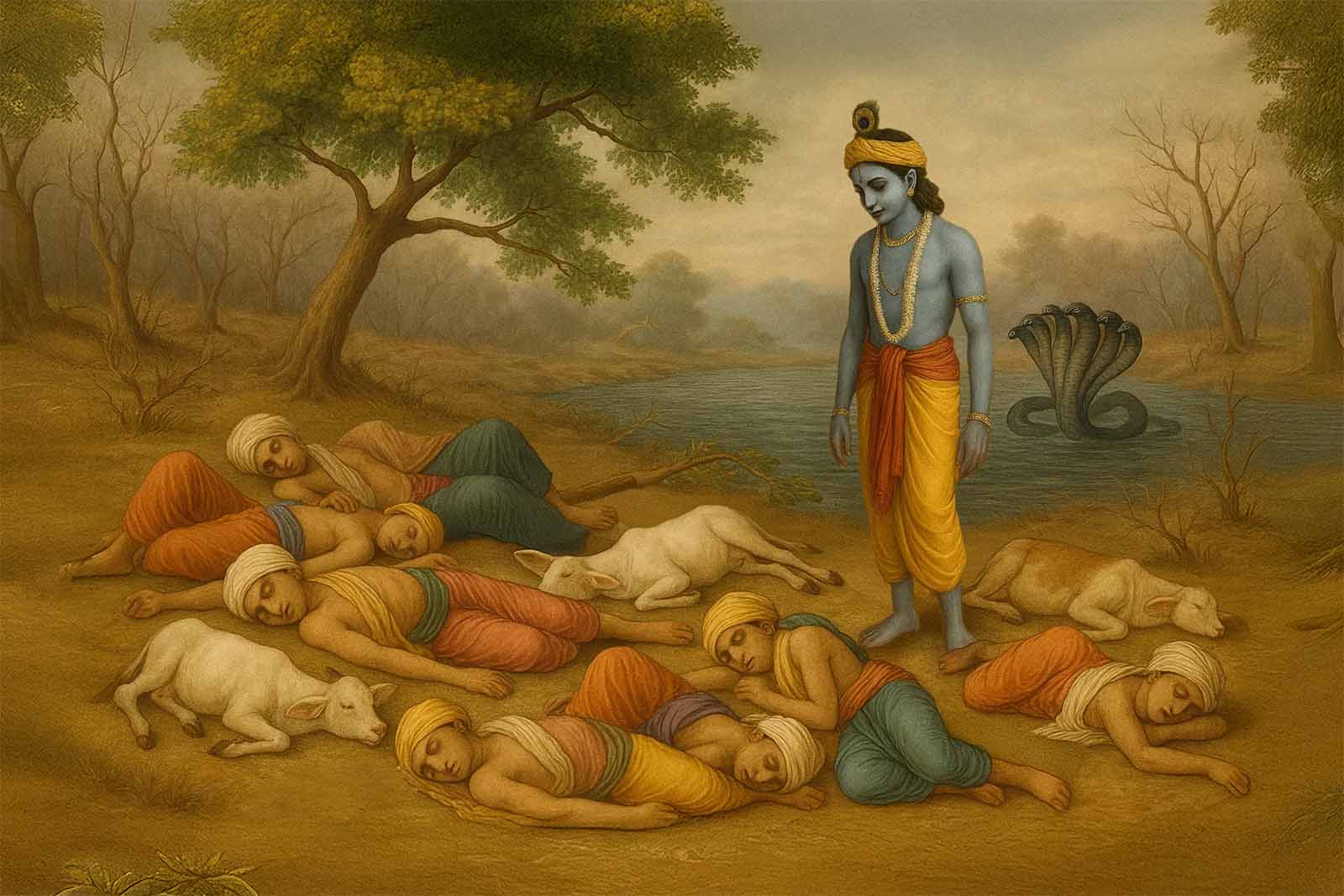
Similarly, in the time of Kṛṣṇa, the water had been poisoned – not by factories or sewage, but by the poison of Kāliya. We call Kāliya a ‘serpent’ or a ‘snake,’ but actually he was a monster. He was no ordinary snake. He had a hundred heads and his poison was so strong that it had polluted the whole lake. Everything in the area was dead due to the poisonous fumes – the trees, the grass, everything had died except for one kadamba tree which previously, Garuḍa had poured some nectar on before he was cursed. *Otherwise, the whole area was contaminated. Even when birds flew overhead, they would immediately die and fall out of the sky. So, when the cowherd boys and calves drank the water, they immediately fell unconscious – but not by the poison. Poison is something of this world. It cannot affect anything in the spiritual world. There are two levels of the spiritual world – one is called Gokula and the other is called Goloka. Gokula is the Vṛndāvana here in this world, near Mathurā, in India. That Gokula comes in touch with the material world. It is like an interactive website. You are interacting with a website, but where is that website? It is far away, somewhere else in the world, but it is coming to you via your computer and you are interacting with that. At the same time, you cannot change it. You can only interact with it as much as you are allowed to. That is Gokula. Kṛṣṇa comes to this earth and interacts with it. Demons only have a limited interaction with Kṛṣṇa, Vṛndāvana, and His devotees, so although the water of the Yamunā was poisoned, it was not possible for that poison to kill any of Kṛṣṇa’s associates. They don’t even have the material bodies to be killed because they are already liberated beings. But where is the fun in that? The whole point of līlā is that Kṛṣṇa is out for fun, and that is called rasa. Sometimes Kṛṣṇa puts His devotees into difficulty just so that He can save them. Therefore, by the will of Kṛṣṇa and the arrangement of Yogamāyā, all these boys and the calves drank the poisoned water and became unconscious. But then, Kṛṣṇa simply looked at them, and immediately, they all woke up again.
*Note: The Purāṇas state that only the kadamba tree on the shore of the Yamunā remained unaffected by the poison of Kāliya because Garuḍa once sat in the tree drinking some nectar. The kadamba tree lived with the hope of being blessed by the touch of Kṛṣṇa’s lotus feet in the future.
(The Cowherd Boys poisoned by Kāliya’s venom)
Kṛṣṇa – The Supreme Dramatist
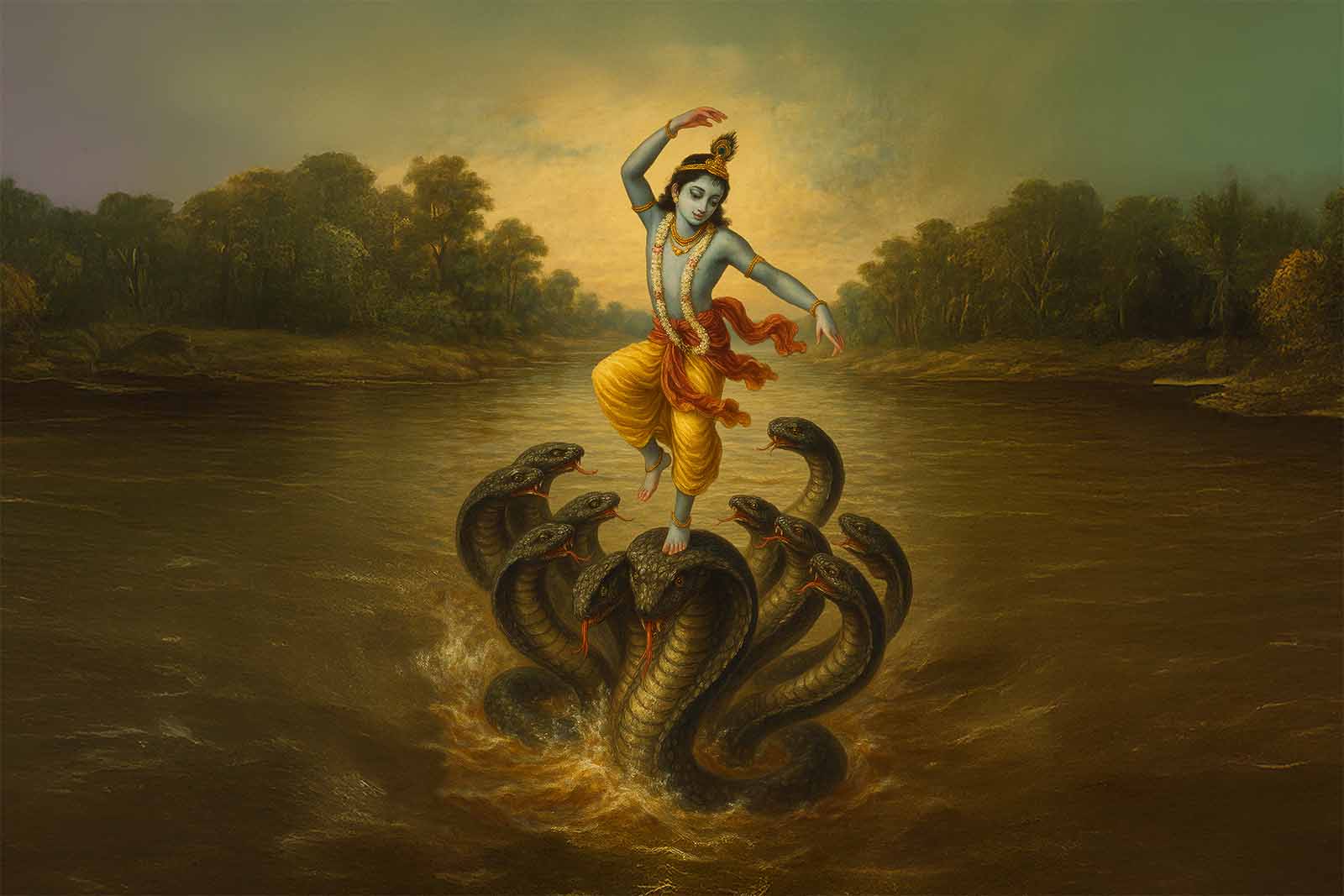
Kṛṣṇa climbed up on the kadamba tree and plunged into the lake to fight with Kāliya. Immediately, Kāliya coiled himself around Kṛṣṇa and began to bite Him on the chest. All of Kṛṣṇa’s friends and family were on the bank watching this and were all under the impression that He was in grave, grave danger. Kṛṣṇa is the Supreme Dramatist and really knows how to bring out the drama. He makes it appear as if He is losing and right on the verge of death. He is in the clutches of Kāliya, and then He vanishes – pulled underwater by Kāliya. Just bubbles… The whole village is screaming, beating their heads, pulling their hair, and fainting. Everybody is crying – the gopīs are crying, His mother is crying, they’re all fainting and in great fear, and just when everybody’s about to breathe their last breath and it’s about to tip over the edge, suddenly Kāliya bursts out from the water like a hurricane and there’s Kṛṣṇa – just dancing on His hoods, smiling as He plays the flute, and everyone breathes a huge sigh of relief – but suddenly, He goes under again! Everyone watching wasn’t thinking, “Oh, it’s okay! Kṛṣṇa’s just playing.” With everything He does, they go with the rhythm. If He’s playing, “I’m going to be killed” then they’re thinking, “He’s going to be killed!” And when He does the opposite and says, “See how I’m the Lord of the Universe!” Everyone thinks, “Ah yes, Kṛṣṇa is the Lord of the Universe!” At every stage in His līlā, they are right there with Him. That is called Yogamāyā. Generally, when these things occur, only Lord Balarāma knows what’s happening, and sometimes even He doesn’t fully know. But when He does, He doesn’t say anything because He doesn’t want to spoil the drama.
The Inner Reason for Kṛṣṇa’s Dancing on Kāliya
At such a serious moment, the Lord suddenly exhibited His artistic nature. If we were captured by such a monster as Kāliya, or even attacked by a shark in the ocean, in the middle of being caught in the jaws of death, we would not start displaying our artistic skills – not unless we were the Supreme Lord controlling everything. Had Kāliya been a shark, Kṛṣṇa would simply have danced across his teeth! In this case, Kṛṣṇa was using the heads of a vicious hundred-hooded cobra, who is lashing out at Him and trying to bite Him, as a platform to dance. The most significant thing in this līlā is that He was sending a message to the gopīs of what was to come. “I’m practicing! Do you see My dancing? See My footwork!” Kṛṣṇa’s chastising Kāliya is a prelude to the rāsa-līlā, and this was a sneak preview.
Kāliya-Kṛṣṇa or Kāliya-mardana Kṛṣṇa?
With every graceful move of His foot, Kṛṣṇa pushed down and crushed each of Kāliya’s hoods and ultimately smashed his pride. In our āśrama, we have a beautiful Deity of Kāliya-mardana Kṛṣṇa, and sometimes I hear devotees call Him, ‘Kāliya-Kṛṣṇa.’ It’s not actually correct – that’s like saying Kṛṣṇa-Balarāma or Rādhā-Kṛṣṇa. Kāliya is not a consort, an expansion, or an eternal associate of the Lord. He’s being kicked, subdued, and chastised, so we call that form of the Lord ‘Kāliya-mardana Kṛṣṇa’ – Kṛṣṇa who is chastising Kāliya.
(Narasiṅgha Mahārāja’s deity of Kāliya-mardana Kṛṣṇa)

Kāliya – the Carrier of Kṛṣṇa
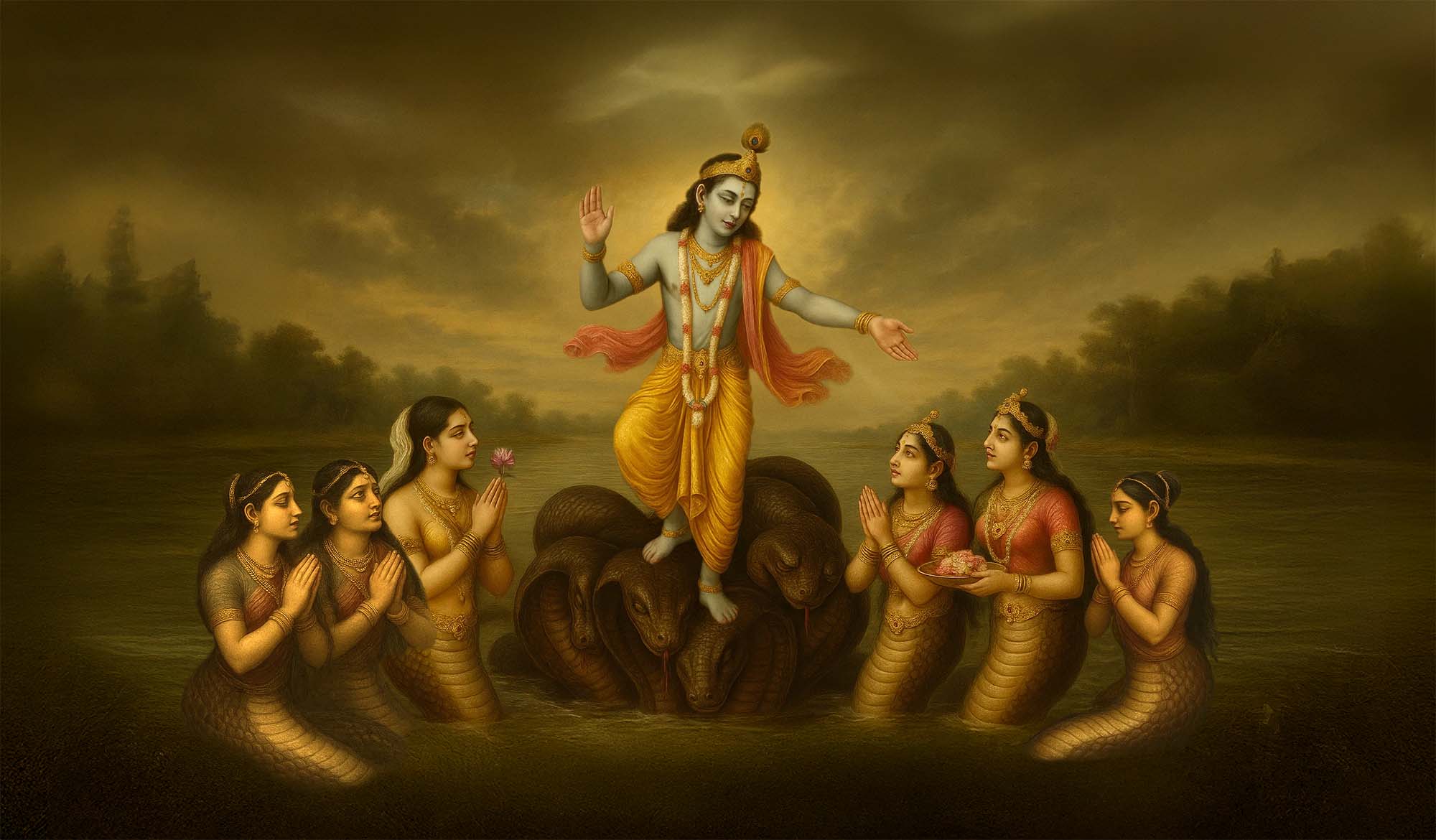
Kāliya’s wives, the Nāga-patnīs, then offered prayers to Kṛṣṇa and begged Him to forgive their husband for his offences, and Kāliya himself also prayed to the Lord. After being beaten by Kṛṣṇa, Kāliya became purified and was told to leave Vṛndāvana and go and live in the ocean. Even after being banished, Kāliya volunteered his services and told the Lord that if ever Garuḍa was too busy, he would become the Lord’s carrier. In his commentary to the Bhāgavatam, Viśvanātha Cakravartī Ṭhākura points out that it is mentioned in one Purāṇa, that in another kalpa, when Kṛṣṇa goes to Mathurā, He calls for Kāliya and travels there on him.
The Significance of Kṛṣṇa’s Defeating Kāliya
Kāliya surrendered to Kṛṣṇa and bowed his head, but other demons didn’t do that. Kṛṣṇa tells them, “Make a choice – bow your head, or lose your head!” That is why Kāliya wasn’t killed by Kṛṣṇa. Only his demonic tendencies were killed. It was necessary for Kṛṣṇa to physically beat Kāliya. He could have simply sat on the bank of the Yamunā and spoken Bhagavad-gītā to him, but to understand that, one must have some piety and sukṛti. When a person has no sukṛti and they are completely dominated by envy and hatred, then sometimes the rod of chastisement is necessary.
Śrīla Bhaktivinoda Ṭhākura has explained that Kāliya represents pride, deceit, harming others and cruelty. These are enemies of anyone desiring to advance in Kṛṣṇa consciousness. Therefore, these anarthas must be driven out of one’s heart. The Kāliya serpent being banished from Vṛndāvana by Kṛṣṇa is a clear indication that without eliminating pride, deceit and cruelty from one’s heart, one cannot expect to become a resident of Vraja.
Mahāprabhu and Kāliya Ghāṭa
In the Caitanya-caritamrta it is told that when Mahāprabhu came to Vṛndāvana, He stayed at Akrūra Ghāṭa, and every morning, the villagers would come there and tell Him, “Last night we saw Kṛṣṇa dancing on Kāliya at Kāliya Ghāṭa! We saw the jewels shining on Kāliyā’s hood. You should come and see!” Mahāprabhu told them, “That is not Kṛṣṇa!” Even His servant wanted to go and see, and Mahāprabhu gave him a good slap! “You are supposed to be a big paṇḍita, but you are talking like a fool! All these people are fools and they are making you into a first-class fool also!” Eventually, some persons came to see Mahāprabhu and told him, “Actually, at night there is one fisherman in his boat on the Yamunā, and he has a lamp in his boat. Some people see the lamp and think that this is the jewel on the head of Kāliyā and the fisherman is Kṛṣṇa.” From this, we can see that this sort of thing has been going on forever – one liar deluding another liar. One person tells the guy next to him, “Wow! I saw that. Did you see that too?” and the other fellow will say, “Er…yeah, I saw it!” In this way, it goes on. At Nidhivana in Vṛndāvana, there is a lot of very fine sand on the ground and if you go there in the morning for darśana, sometimes the pūjārīs will show you these little footprints on the ground – “Oh just see! Rādhā and Kṛṣṇa were dancing at night!” “Oh, very nice!” “Now put some money on the footprints!” This is all nonsense! If you look carefully, those ‘footprints’ were made by the pūjārī pushing the side of his hand in the sand and making toe-marks with his fingers. But the common people fall for all these cheap tricks.
(Narasiṅgha Mahārāja and Tripurāri Mahārāja at Prabodhānanda Sarasvatī’s samādhi in the 1990s)

Śrīla Prabodhānanda Sarasvatī at Kāliya Ghāṭa
Just behind Kāliya Ghāṭa is the samādhi and bhajana-kuṭīra of Prabodhānanda Sarasvatī. Prabodhānanda Sarasvatī is one of the five ‘gems’ that Mahāprabhu found in South India. These gems were Rāmānanda Rāya in Kovvur, the two books Brahma Saṁhitā and Kṛṣṇa Karṇāmṛta, Gopāla Bhaṭṭa Gosvāmī and Prabodhānanda Sarasvatī. In kṛṣṇa-līlā, he is Tuṅgavidyā, one of the aṣṭa-sakhīs, the main gopī-friends of Śrīmatī Rādhārāṇī. He’s also the uncle of Gopāla Bhaṭṭa Gosvāmī. Originally, he was a Śrī Vaiṣṇava tridaṇḍi-sannyāsī from Śrīraṅgam, but he became a Gauḍīya Vaiṣṇava and came to live in Vṛndāvana. We don’t hear anything about Prabodhānanda Sarasvatī in the Caitanya-caritāmṛta, but we understand something about him from the works of the other Gosvāmīs and Gauḍīya Vaiṣṇava ācāryas.
Prabodhānanda Sarasvatī has written many wonderful books in praise of Rādhā-Kṛṣṇa and Mahāprabhu. Nobody can match his attachment for Vṛndāvana. We see many devotees are always looking for a train ticket to get out of Vṛndāvana – after a few months they want to go somewhere else. But Prabodhānanda threatens, “If someone tries to take me out of Vṛndāvana, I will kill them!” Who can match such sentiments? At first, Prabodhānanda lived at Kāmyavana, but later he came to do his bhajana in Vṛndāvana behind Kāliya Ghāṭa.
Śrī Kāliya-mardana Kṛṣṇa ki jaya! Śrī Kāliya Ghāṭa ki jaya! Śrīla Prabodhānanda Sarasvatī ki jaya!
Related Articles and Books
📚Pilgrimage With Swami Narasiṅgha Series Index 📚 Prema Dhāma Deva Stotram with the Narasiṅgha Sevaka Commentary Series Index 📖 In Search of the Ultimate Goal of Life by Śrīla A.C. Bhaktivedānta Swami Prabhupāda 📖 Śrī Dāmodara Kathā by Śrīla Bhakti Gaurava Narasiṅgha Mahārāja 📖 Prabhupāda Vijaya by Śrīla Bhakti Gaurava Narasiṅgha Mahārāja The Ontological Position of Śrī Śrī Rādhā-Govinda by Śrīla B.R. Śrīdhara Deva Gosvāmī Śrī Govardhana Pūjā by Śrīla Bhakti Rakṣaka Śrīdhara Deva Gosvāmī The Vṛndāvana Express and the Navadvīpa Special by Śrīla Bhakti Rakṣaka Śrīdhara Deva Gosvāmī Vraja Bhāva by Śrīla Bhakti Gaurava Narasiṅgha Mahārāja The Worship of Govardhana by Śrīla Bhakti Gaurava Narasiṅgha Mahārāja Dāsa Gosvāmī and the Unique Position of Govardhana by Śrīla Bhakti Gaurava Narasiṅgha Mahārāja Ācāryas at Śrī Śrī Rādhā-Dāmodara Temple, Vṛndāvana by Śrīla Bhakti Gaurava Narasiṅgha Mahārāja Pilgrimage to Vṛndāvana-dhāma by Śrīla Bhakti Gaurava Narasiṅgha Mahārāja The Appearance of Rādhā-kuṇḍa by Śrīla Bhakti Gaurava Narasiṅgha Mahārāja
Further Reading
Rādhā-kuṇḍa and Śyāma-kuṇḍa by Śrīla Bhaktivinoda Ṭhākura Śrī Śrī Raghunātha Dāsa Gosvāmī by Śrīla Bhaktivinoda Ṭhākura Vṛndāvana by Śrīla Bhaktivinoda Ṭhākura