Pilgrimage with Swami Narasiṅgha – Part 8 Govardhana
Pilgrimage with Swami Narasiṅgha – Part 8: Govardhana
Continuing with our pilgrimage series, in time for Govardhana Pūjā, Śrīla Narasiṅgha Mahārāja takes us on parikramā of Govardhana Hill. Mahārāja speaks something of the glories of Girirāja as well as the pastimes and history of some of the places around Govardhana. This article has been adapted from a number of talks given by Śrīla Narasiṅgha Mahārāja. Because of the length of this article, a separate article on Rādhā-kuṇḍa and Śyāma-kuṇḍa will be posted later.
Articles in this series:
Pilgrimage With Swami Narasiṅgha – Part 1: Imlitalā Pilgrimage With Swami Narasiṅgha – Part 2: Śrī Śrī Rādhā-Dāmodara Temple Pilgrimage With Swami Narasiṅgha – Part 3: Śrī Śrī Rādhā-Govinda Mandira Pilgrimage With Swami Narasiṅgha – Part 4: Kurukṣetra Pilgrimage With Swami Narasiṅgha – Part 5: Śrī Śrī Rādhā-Ramaṇa Temple Pilgrimage With Swami Narasiṅgha – Part 6: Śrī Śrī Rādhā-Madana-mohana Temple Pilgrimage with Swami Narasiṅgha – Part 7: Keśī Ghāṭa Pilgrimage with Swami Narasiṅgha – Part 8: Govardhana Pilgrimage with Swami Narasiṅgha – Part 9: Rādhā-kuṇḍa & Śyāma-kuṇḍa Pilgrimage with Swami Narasiṅgha – Part 10: Kāliya Ghāṭa
When we lived in Vṛndāvana, on the day of Govardhana Pūjā, we used to go to Govardhana Hill and I would boldly announce, “Actually, I don’t believe in any religion other than the worship of Govardhana, and my religious principle is to walk around Govardhana Hill!” Some may think that is a strange thing to say, but if you go to Govardhana Hill you will see, “Oh yes! This is where religion is so sweet.”
In Vraja, on the day of Govardhana Pūjā, for hundreds of kilometres in every direction, there is not a temple or a house, or even a deranged man or woman roaming the street, who is not worshipping Govardhana. Even the animals, the trees and the plants worship Govardhana in some form or another. On that day, thousands and thousands of people do parikramā of Govardhana Hill throughout the day and night.
It is said that in the time of Kṛṣṇa, Govardhana Hill was so big that when the sun would go down, the shadow of Govardhana would fall upon Mathurā. You know how big a mountain has to be before that happens? I’ve seen mountains of 13,000 feet cast a shadow for 30 or 40 miles across the Pacific Ocean – you can see that at certain times. Govardhana is called Girirāja, the King of mountains, and there were waterfalls, caves, pastures and all sort of wonderful things on Govardhana Hill. But if we go there now, He’s scarcely 13 metres tall at the highest point with very little vegetation. Where has Govardhana gone? He used to be 10,000 feet high. Some people say, “Oh, a ṛṣi cursed Govardhana to shrink by the size of one mustard seed every day.” But there’s another reason for this.
Uddhava went to Vṛndāvana to visit everybody on behalf of Kṛṣṇa, and pass on some reassuring messages to the vraja-vāsīs. When he returned to Dvārakā, Kṛṣṇa asked him, “How is Vṛndāvana? How are Rādhārāṇī and the gopīs? How are My friends? How are My parents? How is Govardhana? How are the forests?”
Then Uddhava described what he had seen. “Everything is pitiful! There are no forests, everything is strewn with thorns. Your mother and father have grown old and shrivelled. They have no energy. The gopīs are dying and constantly weeping. No one is eating. Cows don’t feed their calves. Everything is dying! Even the great Govardhana Hill has shrunk to a mere pile of rocks.”
“Why?” Kṛṣṇa asked, “Why?”
Then Uddhava told Him, “Because of separation from You.”
So, Vṛndāvana looked like this after Kṛṣṇa left Vraja because of separation – not because of a ṛṣi, not because of the Rajasthan desert encroaching. Those are all external factors. The real reason is that when Kṛṣṇa was present, fruits and flowers were everywhere, and when He was absent, when that part of His *līlā *was withdrawn, then Vraja became very dark – it is not because of some ṛṣi. Of course, if Govardhana wants to accept a ṛṣi’s curse, then that is possible, but otherwise how can some ṛṣi put a curse on Govardhana? It’s not possible, unless He wants to accept that for līlā. Therefore, two explanations are offered.
(Kṛṣṇa lifting Govardhana Hill)
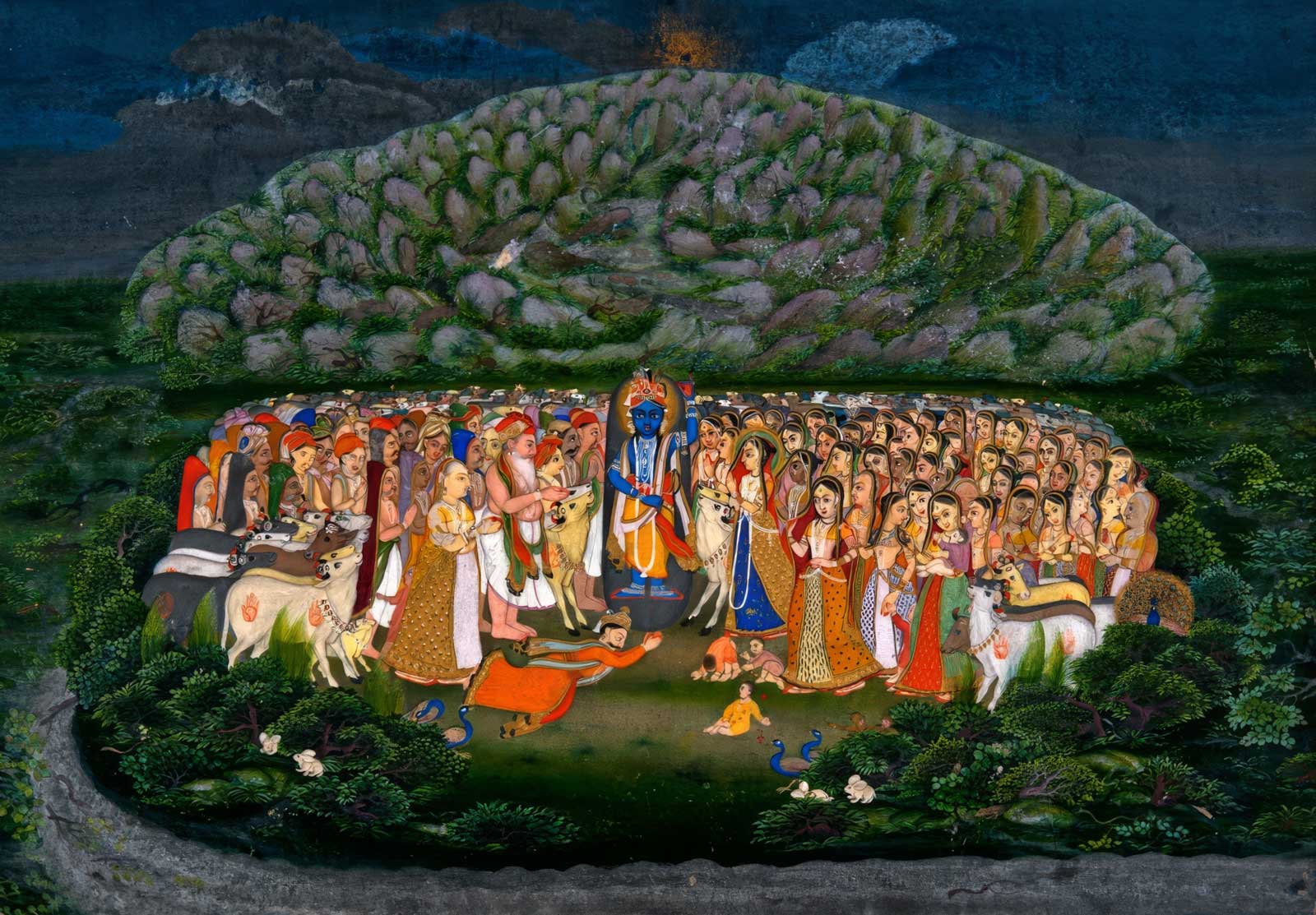
The Pastime of Kṛṣṇa’s Lifting Govardhana Hill
What is the speciality of Govardhana Hill? First, it is important to understand that, especially in ancient times, the Vedic ṛṣis gave a lot of attention to Indra, the king of the Demigods. If you read the Ṛg Veda, Indra seems to get the most attention. Water is a big thing in the Ṛg Veda, and Indra’s specific department is the rain, so it was a tradition for the common people to worship Indra during certain seasons to bless them with rainfall.
Therefore, every year, the residents of Vraja would prepare an indra-yajñā, a big sacrifice for Indra – there would be fire sacrifices and elaborate food offerings made of fruits, vegetables, grains, milk, yogurt, cheese etc. When Kṛṣṇa was seven years old, He saw all the arrangements being made for this big sacrifice, and asked his father, Nanda Mahārāja, “What is all this?”
His father thought, “How will this boy understand what a yajña is?” He replied, “It’s complicated. You wouldn’t really understand, so step aside.”
But Kṛṣṇa pulled on his father‘s coat and said, “We’re one big happy family so why are you keeping secrets? We shouldn’t keep secrets amongst family members.”
Finally Nanda Mahārāja told him, “We’re performing a sacrifice.”
Kṛṣṇa asked, “Please explain who is this sacrifice goes to and what is its purpose?”
Nanda Mahārāja explained the intricacies of the worship of Indra to Him – “Indra is the Deva who is providing the rain; from the rain we get crops and we get grass for the cows. We have been doing this pūjā to Indra since my father’s time, my grandfather’s time, and even beyond that.”
Nanda Mahārāja had a very solid understanding of why the residents of Vraja did this pūjā for Indra every year, but just after he thought he had explained everything nicely and could continue with the preparations, Kṛṣṇa said, “Actually, it’s very easy to see that it is Govardhana Hill that provides our necessities. If you think about it, there are many streams on Govardhana, from which we water our fields. Also, Govardhana gives the grass which is what our cows need, and due to the cows, we cowherds are wealthy. What business do we have with Indra? Worshipping Indra seems quite redundant. Why bother with him? I mean, how intelligent is he? He gives rain all over the place, and he even rains on the ocean! So it’s better to simply offer everything to Govardhana Hill.”
Basically, Kṛṣṇa was speaking atheism, telling his father and the cowherd men, that with or without a sacrifice to Indra, it would rain anyway. Kṛṣṇa spoke in a very child-like way, but when He wants to convince you of something, you don’t stand a chance! Everyone was charmed. No one can resist Kṛṣṇa! The charm of Kṛṣṇa is so beautiful! So sweet! So irresistible! All the vraja-vāsīs decided, “Yes, let us all worship Govardhana Hill.” Then they took everything intended for Indra, and used it to worship Govardhana Hill.
When they began worshiping Govardhana Hill, they saw something very wonderful. Kṛṣṇa, that frolicsome young boy of Vṛndāvana, suddenly became Govardhana. His eyes, face and mouth manifested on the hill, and His arms appeared from the hill and He began eating everything that was being offered. Kṛṣṇa is non-different from Govardhana Hill, but at the same time, Govardhana is considered to be a devotee of Kṛṣna. Raghunātha Dāsa Gosvāmī has referred to Govardhana as ‘Hari-dāsa-varya’ (the best of the devotees of Hari). Śrīla Śrīdhara Mahārāja has explained that in the greater līlā of Kṛṣṇa, Govardhana Hill is a śānta-rasa bhakta. The trees, the rivers, the hills are all in śānta-rasa. Govardhana Hill is a śānta-rasa bhakta, but Kṛṣṇa also becomes Govardhana, so Govardhana holds a very unique position.
The vraja-vāsīs saw that all the foodstuffs that were placed in front of Govardhana Hill were being eaten by Him. That is why we put a face on Govardhana. When the residents of Vṛndāvana saw Govardhana Hill eating, what did they see? One big rock opening up and chomping down on a pile of pakoras? No – they saw the sweet face of Govinda. That is why sometimes we put a face on govardhana-śilās. When we get a govardhana-śilā, we are turning it this way and that way. What are we looking for? We’re looking for the face of our Lord and we paint an outline and put eyes on Him etc. If we paint Kṛṣṇa’s eyes with tilaka on a govardhana-śilā and then rub them off, the eyes are still there. We only paint them on so that we can see them better. If you don’t believe me, just ask the govardhana-bhaktas who worship govardhana-śilā. Almost all of them will show you Kṛṣṇa’s face on their Govardhana. They’re not seeing stone! They are trying to see the sweet form which is non-different from Kṛṣṇa.
Govardhana was worshipped and everyone was very happy, except Indra. He showed up riding his elephant, Airāvata, along with his entourage to receive his offerings, and suddenly saw that everything was being offered to Govardhana Hill. While the residents of Vṛndāvana were seeing the sweet face of Govardhana eating all their offerings, all Indra could see was a bunch of people pushing food up against a mountain, waving incense at it, and smiling at this cowherd boy. First he was embarrassed and then he was infuriated, and he thought, “These foolish villagers have foregone my sacrifice and insulted me! Instead of worshipping me, they are worshipping a hill simply on the advice of a mere child. These people should be punished.”
Indra was so angry that he sent his Sāṁvartaka rain cloud – generally, that cloud only comes at the time of pralaya, universal destruction. Indra threw all his might against the little village of Vṛndāvana. There were hurricanes, thunder, lightning, gale force winds, flooding – huge destruction. Places that would usually give some shelter from the rain were all decimated within moments, and the flood waters rose to dangerous levels all over Vṛndāvana. At that point, the cows were mooing, the ladies were crying, the girls were screaming, “We’re all going to die! We’re all going to die! What do we do now? We’ve angered Indra.”
They were torn between pleasing Kṛṣṇa and dealing with an angry Indra. For a moment, they were at a complete loss. What to do? They turned to Kṛṣṇa for shelter. Then Kṛṣṇa said, “Govardhana has always been our provider. Why would He forsake us now?”
Then all the people, cows, animals, and birds headed for the high ground and came to Govardhana Hill for shelter.
Kṛṣṇa was only seven years old, but He had already dispensed with a number of demons prior to this. There were already rumours about Him – “He may be a demigod, He may be even Lord Viṣṇu. At any rate, He’s very powerful, and He’s very lucky. He kills so many demons” Therefore, everyone turned to Kṛṣṇa for protection. So while Indra was throwing his might against Vṛndāvana, Kṛṣṇa reached over with His left hand, caught the edge of Govardhana Hill with His little finger, and raised it over everyone’s heads, like a massive umbrella.
There is a reason why He used His left hand. Most people are right-handed. Generally, the right hand is more powerful and the left is a little weaker. Of course, Kṛṣṇa has no strong arm or weak arm – He can lift Govardhana Hill with either hand, but the meaning of this is that with the most negligible endeavour, He can give all protection to His devotees and defeat any opposing forces. There is no need to fear approaching Kṛṣṇa. There is no need to fear that you will be in want of anything. Tests may be there. We may be put to the test in different ways – individually, or collectively. If somebody goes for some particular sport or in the military, there is rigorous training and many tests. Why? Because the tests are designed so that you will achieve more.
Indra kept throwing rain for seven days and seven nights non-stop, but underneath Govardhana Hill there was no wind, no rain, nothing! Nobody felt sleepy, nobody felt hunger, nobody felt thirst, nobody felt cold. Govardhana Hill gave complete shelter to everyone. And while Kṛṣṇa was standing, holding Govardhana with the little finger of His left hand, the cowherd boys wanted to get in on the act too. So they all raised their cowherd sticks and stuck them up next to the hill. “We’re here! We’re helping out too.” Kṛṣṇa was happy to see that.
Finally, Indra realised his mistake and offered prayers to Kṛṣṇa. Indra is a devotee of Viṣṇu, but he didn’t understand who Kṛṣṇa was. Indra begged forgiveness, “I didn’t recognise You. Please excuse me for trying to kill You and all Your friends.”
(Indra offers prayers to Kṛṣṇa)

Govardhana – Our Shelter and Eternal Residence
Amongst other things, Kṛṣṇa’s pastime of lifting Govardhana and defeating Indra is Kṛṣṇa’s direct instruction to His devotees that the worship of minor demigods for material gain is unnecessary and an obstacle to bhakti. “Only I am to be worshiped. I am the one Supreme Being, and everything should be offered to Me. There is no necessity to worship any other demigod.” Another aspect we can draw from this pastime is that the shelter of Govardhana Hill is the necessity of all. Govardhana is the Supreme Deity of our sampradāya. Without taking shelter of Govardhana, one cannot approach the rāsa-līlā, one cannot approach any position of intimacy within the realm of kṛṣṇa-līlā. For all those who aspire for vraja-bhakti, Govardhana is the supreme shelter. That is why Śrīla Raghunātha Dāsa Gosvāmī and many great devotees lived at Govardhana and found tremendous inspiration there.
In our Gauḍīya Vaiṣṇava sampradāya, Śrīla Raghunātha Dāsa Gosvāmī is called the prayojanācārya. That means that what he has expressed and given to us in his writings is taken to be the highest goal of kṛṣṇa-bhakti. In his Stavāvalī, after offering his obeisances to Śrī Gaurāṅga Mahāprabhu and after his Manaḥ Śikṣā, then Dāsa Gosvāmī first appeals for the shelter of Govardhana Hill, and then he pleads with his innermost heart to be accepted and given some residence at Govardhana. Also, the reason why Śrī Caitanya Mahāprabhu gave Dāsa Gosvāmī a govardhana-śilā was to tell him that, “This is your eternal place of residence.” The meaning of this is that for the Gauḍīya Vaiṣṇavas, the followers of Śrī Rūpa and Śrī Raghunātha, the shelter of Govardhana is their eternal place of residence. For those who are blessed enough to receive a place in the Lord’s eternal pastimes, they are all at Govardhana Hill. Our sampradāya stems from Govardhana. In *kṛṣṇa-līlā, *all of our ācāryas are from the village of Govardhana.
Sometimes, the sahajiyās will ask us about eka-daśa-bhāva (the eleven aspects of one’s gopī-svarūpa). For example, they will ask, “Has your guru given you your eternal place of residence, your place of service?”
And very proudly, we will reply, “Yes! He has given!” Then they are shocked, because generally, devotees will say, “No, no – we don’t follow that.” But we will say, “No! He has given!”
“Oh, what is that?”
“Well, you don’t seem to be the type of man who has the qualification to understand such a thing.”
But Raghunātha Dāsa Gosvāmī has disclosed that our eternal shelter and residence is Govardhana, and that our place of service – not our place of residence, is to aspire for the service of the Lord at Rādhā-kuṇḍa, which is the highest possible achievement with all blessings and all perfection.
(Raghunātha Dāsa Gosvāmī and his Govardhana-śīlā)


**Śrīla Prabhupāda and Govardhana **
A few weeks before his departure in the month of Kārttika, Śrīla Prabhupāda suddenly manifested a strong desire to go to Govardhana Hill. At that time, he couldn’t even sit up, what to speak of move or walk. He wanted to go to Govardhana Hill at any cost. “Take me there in a bullock cart! However it is possible, take me to Govardhana Hill. I want to go to Govardhana!”
It came as a shock to all the devotees as they could not tolerate the idea of His Divine Grace making such an arduous journey. They thought, “He can’t be moved from his bed. If he goes to Govardhana Hill, he will leave his body on the spot!” They were thinking from the material perspective. So many things happened in those two or three days, until finally Prabhupāda’s godbrother, Śrīla Kṛṣṇa Dāsa Bābājī Mahārāja came and gave some pacification to Prabhupāda’s heart and his desire was relaxed, at least from the external point of view.
What was His Divine Grace teaching us? What was he actually expressing by telling us that he wanted to go to Govardhana Hill? It was not simply the Govardhana Hill that can be reached by either car or bullock cart which he desired to go to. It was the infinite play of his eternal Lord at Govardhana to which he desired to return. Govardhana is the place of residence for the followers of the Rūpa-Sārasvata line. We are residents of Govardhana, and therefore, Śrīla Prabhupāda began to manifest a desire to go to Govardhana, his eternal residence. So through his disappearance, His Divine Grace was instructing us about these truths.
The Magic of Govardhana
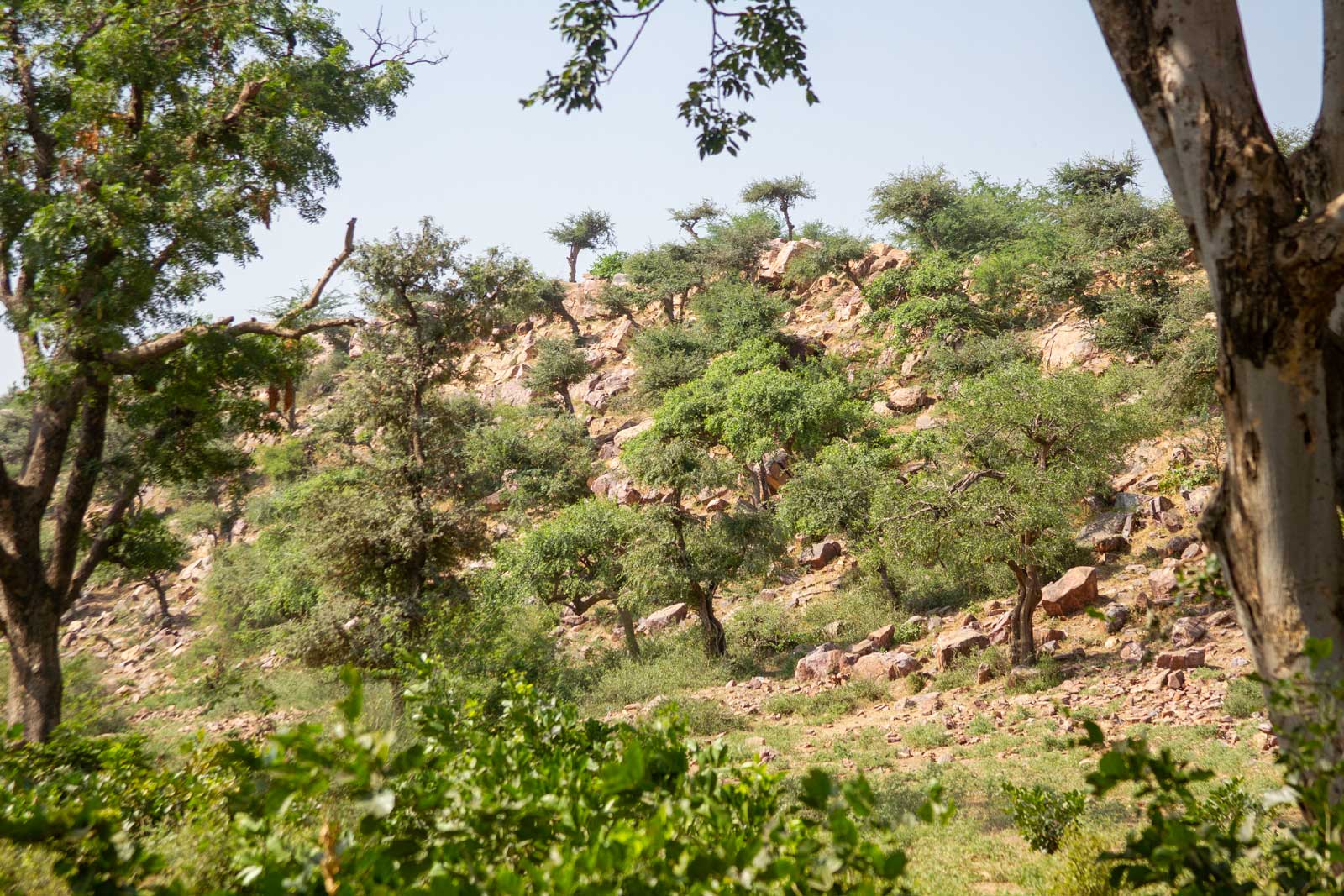
A few years after Śrīla Prabhupāda’s disappearance, one of his close friends named Bhagatjī took me to a forest in Govardhana. Bhagatjī was the person who originally donated the land for the gurukula at Kṛṣṇa-Balarāma Temple. He took me into this forest, looked around, pointed to the ground and said, “Move those leaves.” We brushed the leaves away, and there was only sand. Then he said, “Move that sand.” Then we moved the sand, and there was a big govardhana-śilā with a foot-print of Kṛṣṇa. When we came back out of that forest, I was trying to count the telephone poles so that I could come back to that place. Then, a month later, when I returned, I couldn’t find it. It was somewhere in that forest in Govardhana and only he and probably a few other bābās knew about it. Maybe if I roamed around for a few days, I might find it again. Maybe somebody built a temple there now. There are one or two other places in Vraja where Kṛṣṇa’s footprints have been located. Some bābās have found them because they look over every inch of Govardhana – looking, looking, looking.
There is one small forest we used to go to right next to Govardhana and I used to go around with some brahmacārīs with the speed of a bullet. We would start early and we’d reach a point at Govardhana Hill in the morning, where He turns as blue as blue can be. The air turns blue, the sky turns blue, and the trees show their magic at that time, and you wonder, “What is happening?” We saw that many times – the camatkāra (magic) of Govardhana! Hardly anybody knows this! You just have to be there on the right day at the right time. There, Govardhana is at a slope, and the stone has a purple colour to it. At around 10:30 in the morning, the sun-rays streak across the top and hit this angle, bouncing back up to throw colour in the air which then reflects off the dust. I’m not exaggerating. I have seen it about four times.
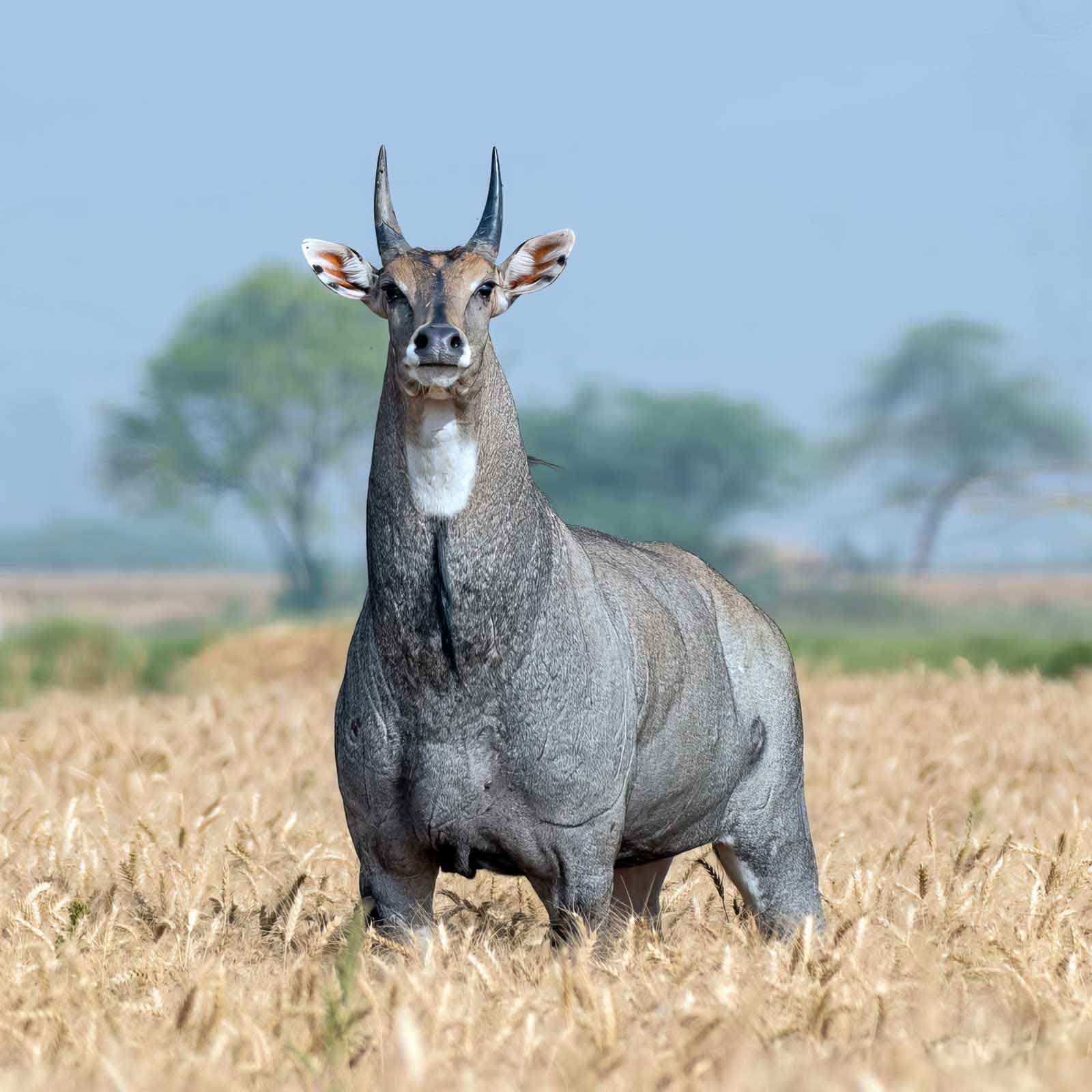
Sometimes, the ‘blue cows’ come. They are wild cows called nīlgāi (blue cows) because when the sun hits them, they are dark blue. The females are like a deer, and the males are like a cross between a horse, a cow and a deer. It is rare to see them. One time, I was in the middle of that ‘blue cloud’ phantasmagoria for about twenty minutes with about thirty devotees, and a whole herd of wild nīlgāi came there. It was so magical.
Doing Parikramā of Govardhana
Many sādhus and pilgrims do regular parikramā of Govardhana Hill, some even doing it twice a day. I have seen groups of young people run around the whole length of Govardhana, and even people doing parikramā in wheelchairs. Some people also do daṇḍavat-parikramā of Govardhana Hill – they lie flat doing daṇḍavats, and put a stone on the ground where their hand is, then they offer daṇḍavats a hundred and eight times, and then they advance to where the stone is and offer daṇḍavats a hundred and eight times again. While offering daṇḍavats, they may also recite some prayers. Sometimes it can take over one year to do that. Other people only offer one daṇḍavat at a time and move on. You can see old ladies in their seventies and eighties doing daṇḍavat-parikramā. However, we never hear that Śrīla Prabhupāda, Śrīla Śrīdhara Mahārāja or Śrīla Purī Mahārāja did daṇḍavat parikramā, nor did they ever mention it anywhere. I’m not even sure if there is a reference in śāstra for daṇḍavat parikramā or even a reference of any of our previous ācāryas doing it – it may just be an old local tradition that caught on.
Some devotees walk around Govardhana with their shoes and get away with it, but if you can’t go bare-foot, it should tell you something about your life. You’ve become so totally sissy-fied by material pleasure that you can’t even walk on the earth anymore. I prefer it that our devotees don’t take their shoes on parikramā. If you really have an issue with your feet, then you can bring your shoes to certain places. But you can’t wear them in all places – you can’t wear them around Rādhā-kuṇḍa, otherwise people are gonna come out and slap you silly! So, you can bring your shoes, but you can’t wear them! They’re just there to pacify your mind that, “Well, if I really need them, they’re there!”
I have seen people come to temples in Vṛndāvana and they are afraid they will lose their shoes. So, they pick up their shoes, put them in a bag and carry them around the temple and do parikramā. That is such a no-no! That is such an uncultured, fifth-class Mleccha thing to do! It happens all the time with the foreigners here. Why are they wearing their $100 shoes here anyway? If you are so worried about losing your expensive shoes, why did you bring them here in the first place?
(Narasiṅgha Mahārāja leading Govardhana Parikramā in the 1990s)

Kusuma Sarovara
Generally, we start our parikramā from Kusuma Sarovara. This is where Śrīmatī Rādhārāṇī and the gopīs would come to pick flowers. Today there is a very grand monument there in front of the lake. I was told by Bhagatjī that once, the king of Gwalior got into a fight with the Shah of Delhi, so he came to Vraja and made a vow that, “If I get a victory over the Shah, I will build a shrine glorifying Rādhā and Kṛṣṇa.” In one sense, you could say that war has nothing to do with Rādhā and Kṛṣṇa. They’re not concerned about any Hindu-Muslim war. Anyway, he was a pious king and eventually he was victorious – he broke the gates of the Shah’s fort, took them away, and that was a big embarrassment to the Shah. The Gwalior king should have gone in and finished him off – end of problem! But these kings were more into insulting people.
For example, there was once a king in Rajasthan who was captured by the Muslims, and they wanted him to bow down to their emperor. He replied, “No, you can cut off my head, but I won’t bow down.” Then they made a plan to force him to bow. They put the emperor in a room with a very small door, and to go through it, one had to bow down very low. They would tell the king to go inside, and as he did, he would have to bow to enter. Then they would shout, “Ha! At last you are bowing to our emperor.”
So they brought him to the door and told him to enter. The king knew what they were planning, so as he went through, he suddenly spun around and showed his backside to the emperor. The emperor were so angry that they chopped off his head on the spot. There was so much pride with the kṣatriyas that this fellow would rather lose his head and insult the Muslim emperor than bow to him.
This kind of ego amongst the kings was very strong back then, right up to the early 20th century. During the British period, the rajas would show up in Delhi, and depending on how big they were and how much money they were contributing, they received a gun salute. The highest was a twenty-one gun salute and that was only given to a few kings like the king of Mysore, the king of Gwalior and the Nizam of Hyderabad. Others got a six or ten gun salute. Sometimes what would happen is that a king would come for a big meeting in a big fancy horse carriage, then one of his servants would bow down next to the door of the carriage and the king would step on his back and get out. Then the king would stand there and listen to the sound of the gun salute and count them – if there were not enough guns going off, he wouldn’t go for the meeting. He’d simply get back into his carriage and go home! This big competition was going on between them all. And for what? It was all ahaṅkāra – false pride. So this was the mood amongst the kings.
(The monument at Kusuma Sarovara)
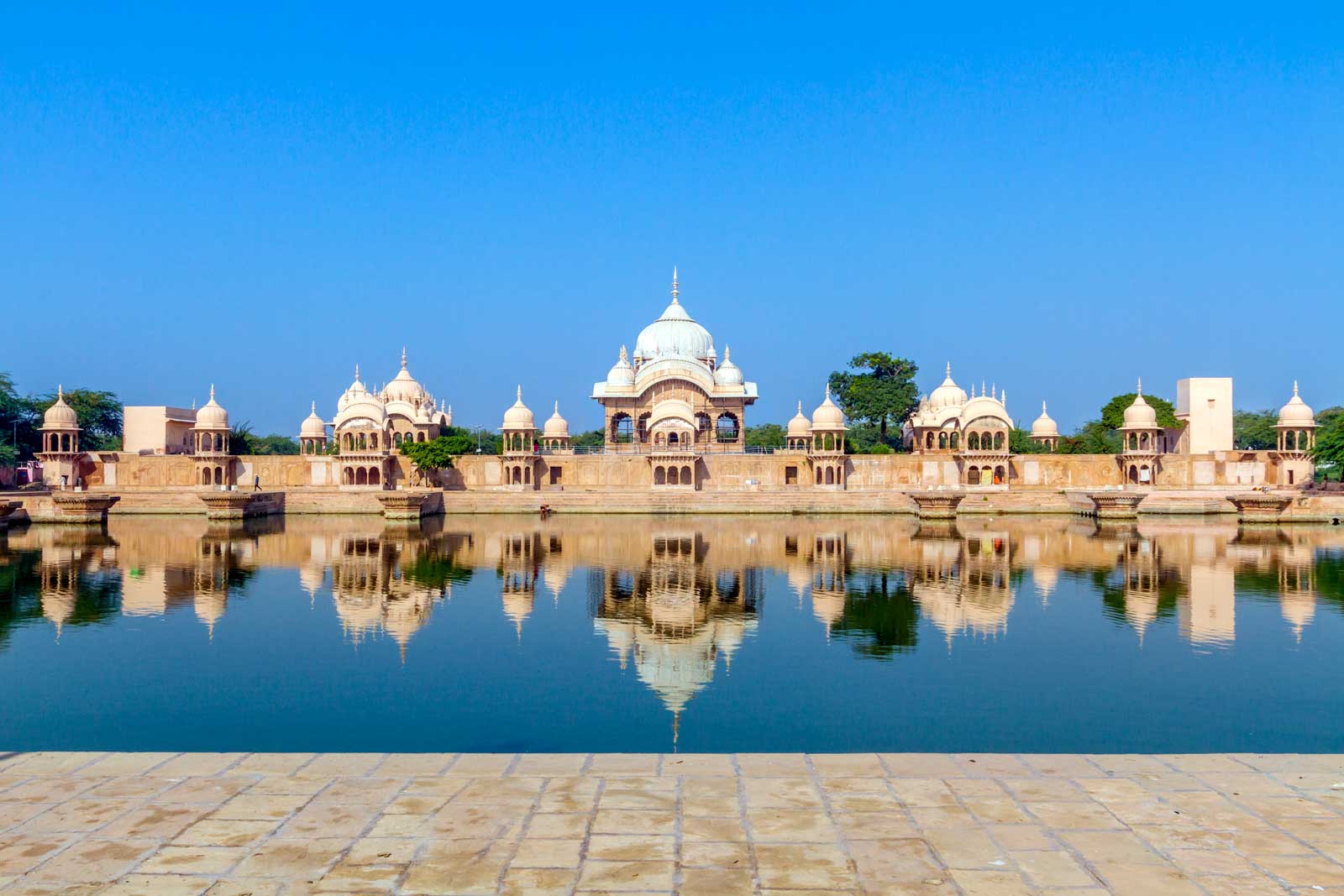
Anyhow, the king of Gwalior tore down the gate and made it into a dining table in his palace as an insult to the Muslims. But to win that war, he needed help and had to approach the leader of the Bhīls who had a big army. The Bhīls were ādivāsīs, or tribal people. The Bhīl chieftain told the king of Gwalior, “If you build this shrine at Kusuma Sarovara, you have to give bathing rights to my wife.” Now we may think, “Bathing rights? Everybody has a right to take a bath, right?” Wrong! Back in those days, there were certain places where only brāhmaṇas bathed, kṣatriyas bathed etc. The Bhīls are not even śūdras – they’re outside the caste system. But because the king needed the Bhīl army, he agreed.
After he won the war and built the monument at Kusuma Sarovara, the king told his queen about his promise to the Bhīl chieftain. She was not happy. Then the lady-problem started – “How I can take bath in that place if this woman is going to bathe there?”
The king thought, “What to do? Better to have a problem with the Bhīls than a problem with my wife,” so he told the Bhīl chief, “Sorry – cancelled!” Then the Bhīls came to Kusuma Sarovara, broke off some of the architecture, took it to their land and made a kuṇḍa for their queen. That was in the jungle and just a few years ago, the government was cutting the jungle, and they found a big platform. That was part of the bathing ghāṭa for the Bhīl queen.
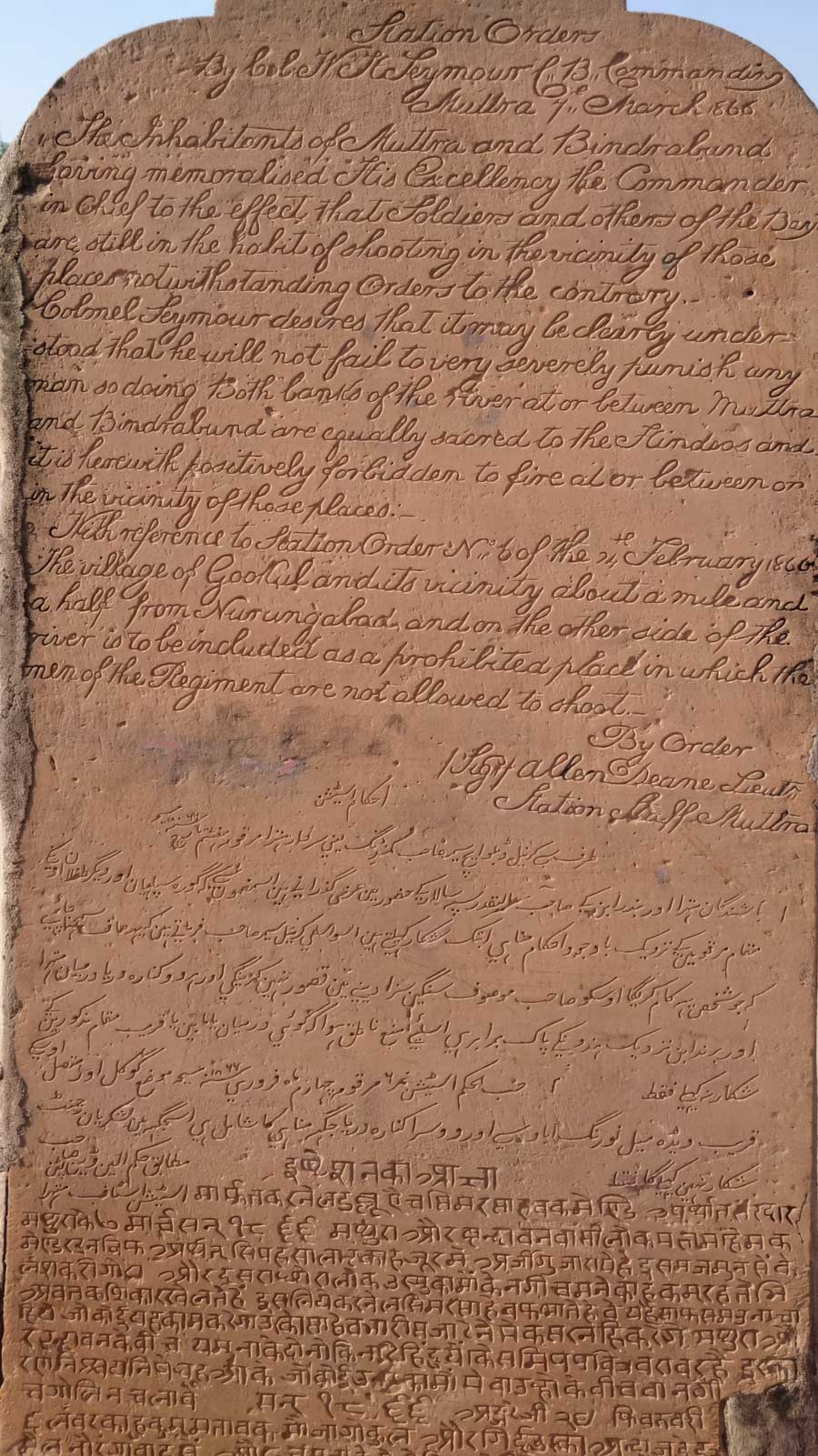
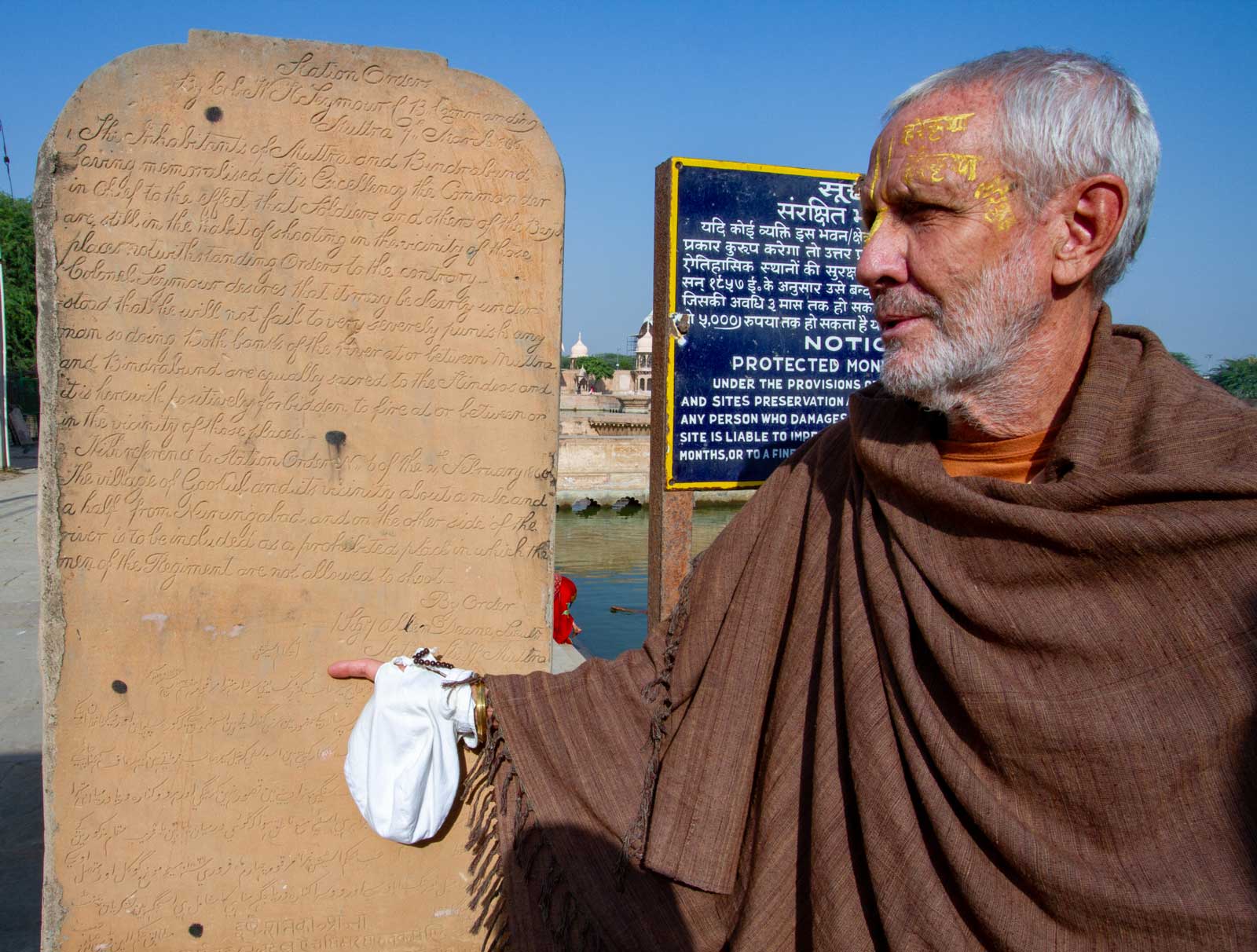
About thirty years ago, I found this big stone stuck in the mud at the side of Kusuma Sarovara. In three languages, Urdu, Hindi and English, it says, “Don’t shoot any animal in Vraja or you’ll be punished by the commander of the fort.” Years later, the Archaeological Survey of India cleaned it up and placed it there.
(The inscription at Kusuma Sarovara)
Nārada-kuṇḍa
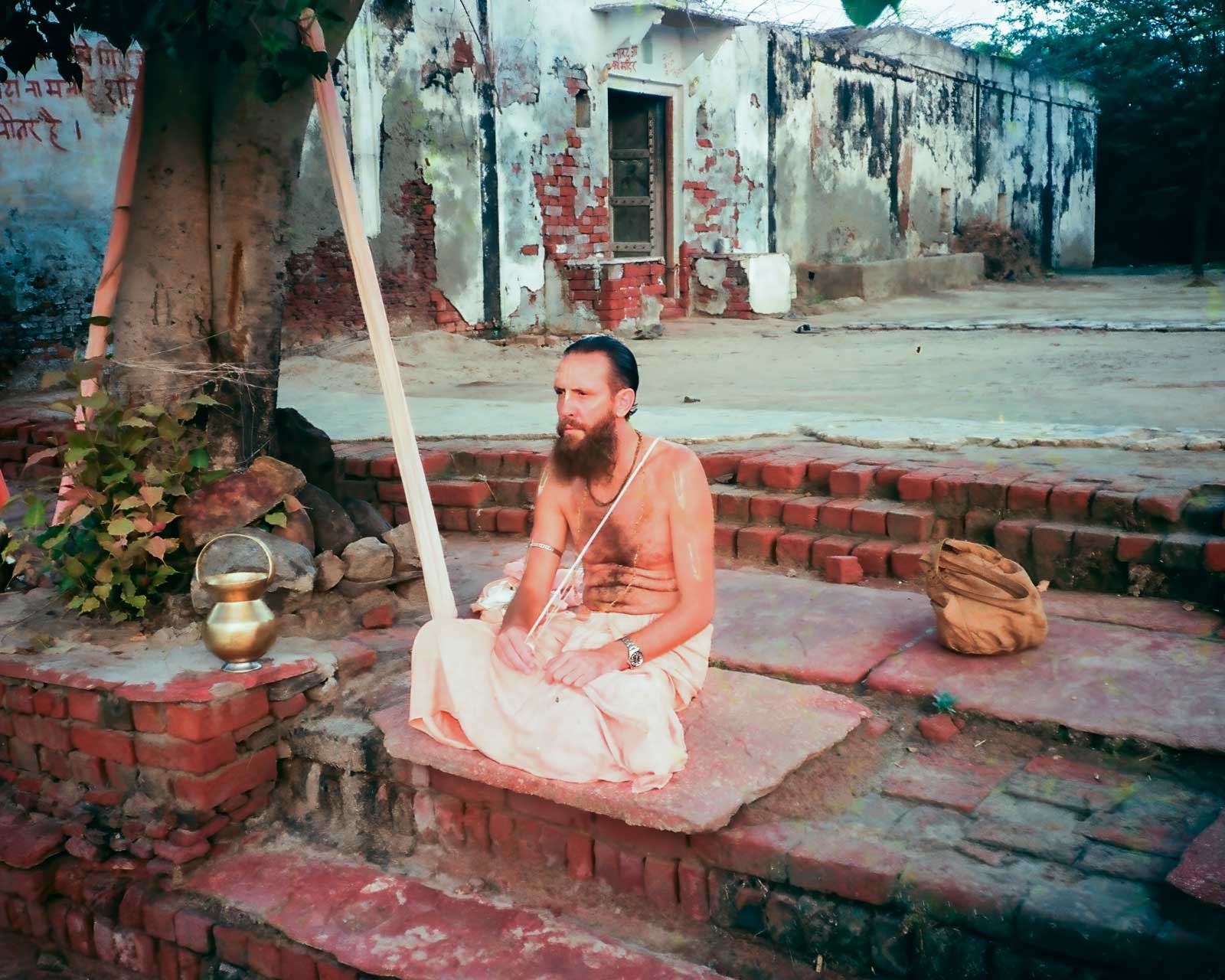
Back in the 1980s, I spent a lot of time at Nārada-kuṇḍa. I’d go there to read and chant because it was a very quiet place – not many people knew about it. We even thought of buying land there and building an āśrama. At that time it was very rustic, but now it’s been renovated and looks first class. It is said that Nārada-kuṇḍa is where Nārada Muni had an āśrama and from there, he went to Kusuma Sarovara, took bath, and received the form of a gopī.
(Narasiṅgha Mahārāja at Nārada Kuṇḍa in 1990)
Mānasī Gaṅgā
There are many lakes around Govardhana, and one of those lakes is called Mānasī Gaṅgā. Mānasī means the mind, and Gaṅgā means the Ganges River. So at a particular time, the villagers of Vraja heard about the glories of the Ganges and they decided, “We should go to the Ganges” – but that’s at least two hundred kilometres away from Vṛndāvana. There is one place on Govardhana Hill, which dips down almost into a small valley, and Kṛṣṇa told them, “No, no. It’s too difficult for you to go all the way to the Ganges – let the Ganges come here!” Then suddenly, the Ganges just bubbled up from the ground and filled this small valley. So, just by thinking about it in His mind, Kṛṣṇa created Mānasi Gaṅgā.
When I come to Mānasī Gaṅgā, I just take some water on my head and go! There are so many pāṇḍas (professional priests) there. If you hang around, they’ll get you. Anything from a nice pūjā to a fist-fight can happen there – and if you don’t give them enough money, it’s usually the latter!

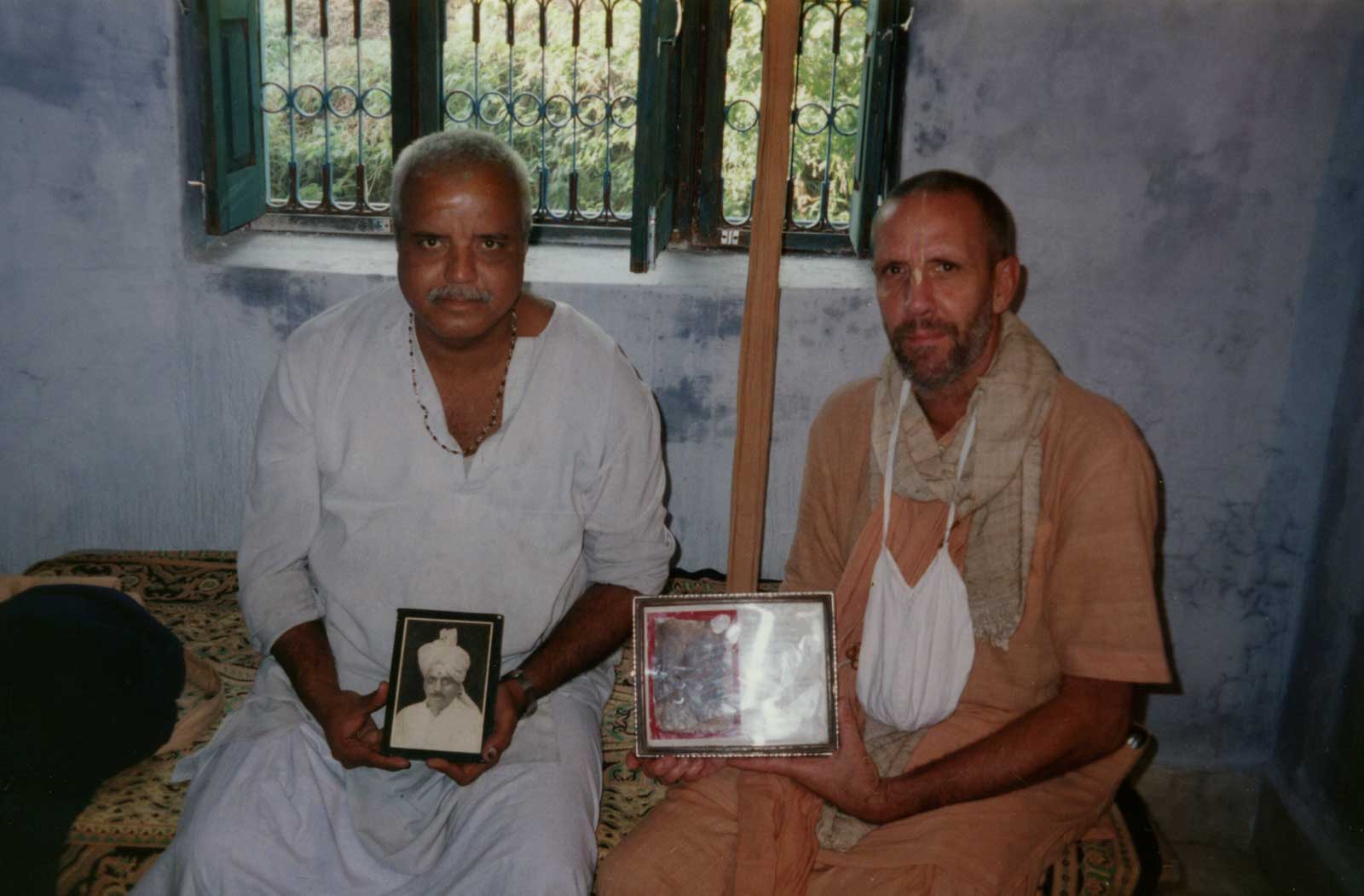
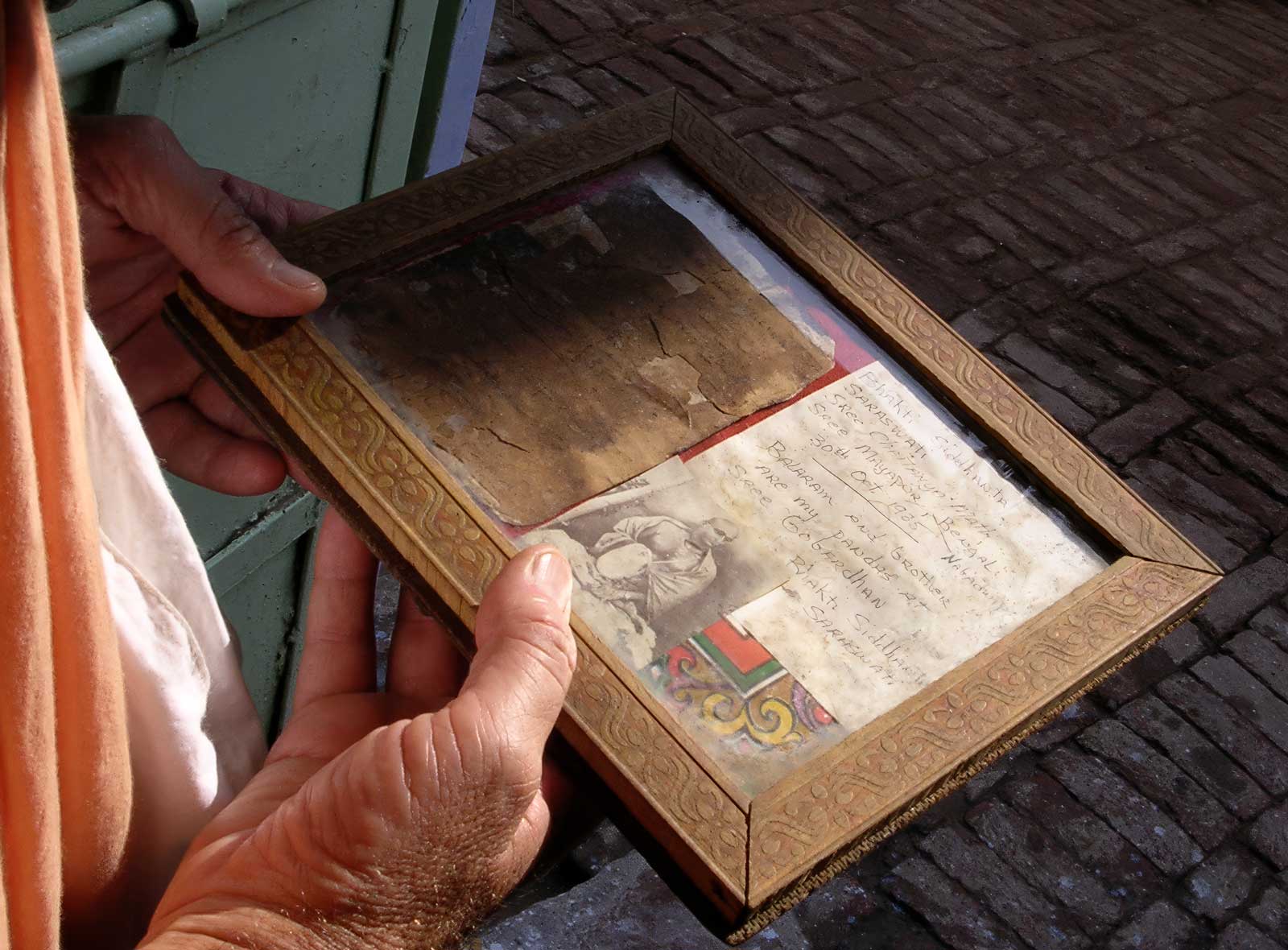
My old friend, Giridhari Pāṇḍa lives at Mānasī Gaṅgā. His father, Balarāma Pāṇḍa, was the official pāṇḍa for the Gauḍīya Maṭha during the time of Sarasvatī Ṭhākura. The night before Sarasvatī Ṭhākura left this world, Balarāma Pāṇḍa had a dream where Sarasvatī Ṭhākura was walking towards him wearing a white kaupīna and telling him, “Balarāma, I have come to Govardhana!” So, the next morning he sent a telegram to Bagh Bazaar Gauḍīya Maṭha in Kolkata and asked if Sarasvatī Ṭhākura was alright, and they replied that he had just passed away. Giridhari Pāṇḍa still has a letter to his father from Sarasvatī Ṭhākura.
(Narasiṅgha Mahārāja with Giridhari Pāṇḍa and the letter of Sarasvatī Ṭhākura)
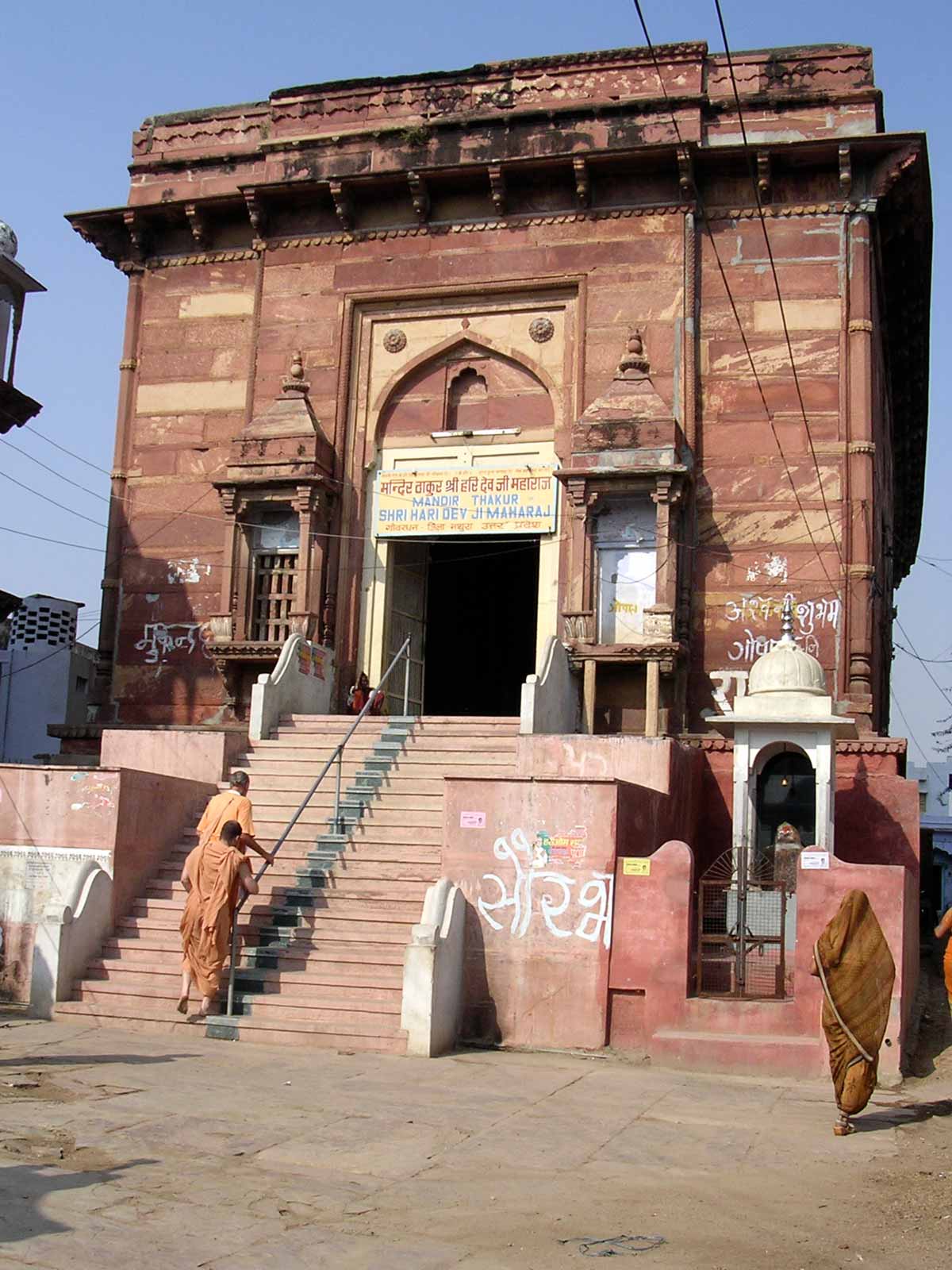
Harideva
The Deity of Harideva is one of the oldest Deities of Kṛṣṇa on the planet, and He is actually Girirāja showing Himself as Kṛṣṇa lifting Govardhana Hill. When Mahāprabhu came to Vraja, He also visited Harideva and danced in front of Him. The Six Gosvāmīs and every great Gauḍīya ācārya who has ever walked this earth from the time of Mahāprabhu did saṅkīrtana in that tiny room in front of the Deity. This temple was built by the father of Man Singh, who built Govindajī Temple, and when Aurangzeb came to Vraja to destroy so many of the temples, they moved the original Harideva to another location and I heard He is still there. The original Deity is self-manifested from Govardhana Hill itself.
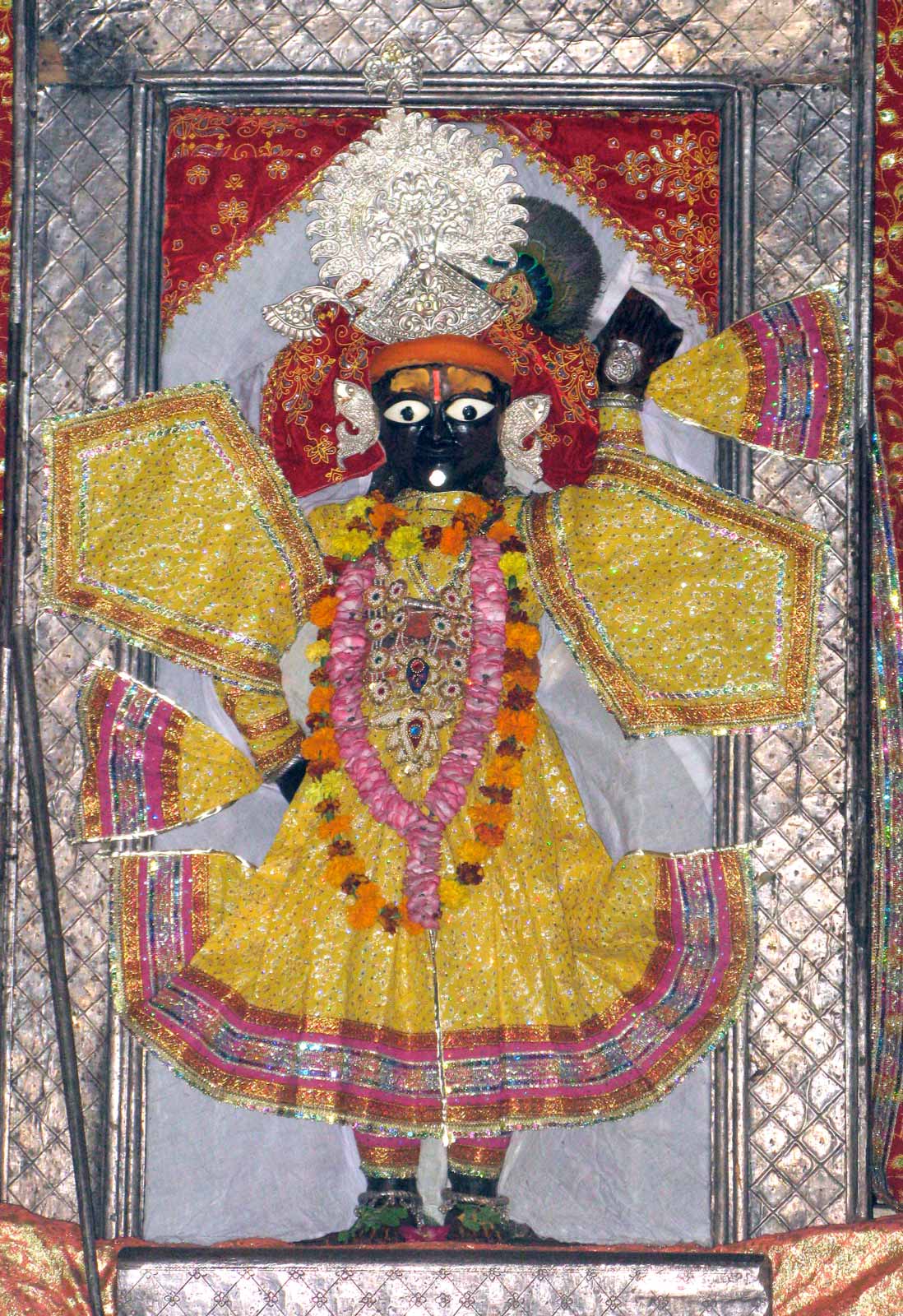
(The temple of Harideva in the 1800s and modern day)
Govinda-kuṇḍa and the Deity of Gopāla
When you go on Govardhana parikramā, you come to a village named Āniyor. Then a little further on, you come to a kuṇḍa at the foot of Govardhana. When Indra was defeated after the lifting of Govardhana Hill, he came there to worship Kṛṣṇa. It was at this time, that Kṛṣṇa first became known as Govinda, the Lord of the cows. Indra and his elephant, Airāvata did an abhiṣeka of Kṛṣṇa with milk which was supplied by Surabhi, the celestial cow. That milk accumulated and formed a lake, which over time became Govinda-kuṇḍa.

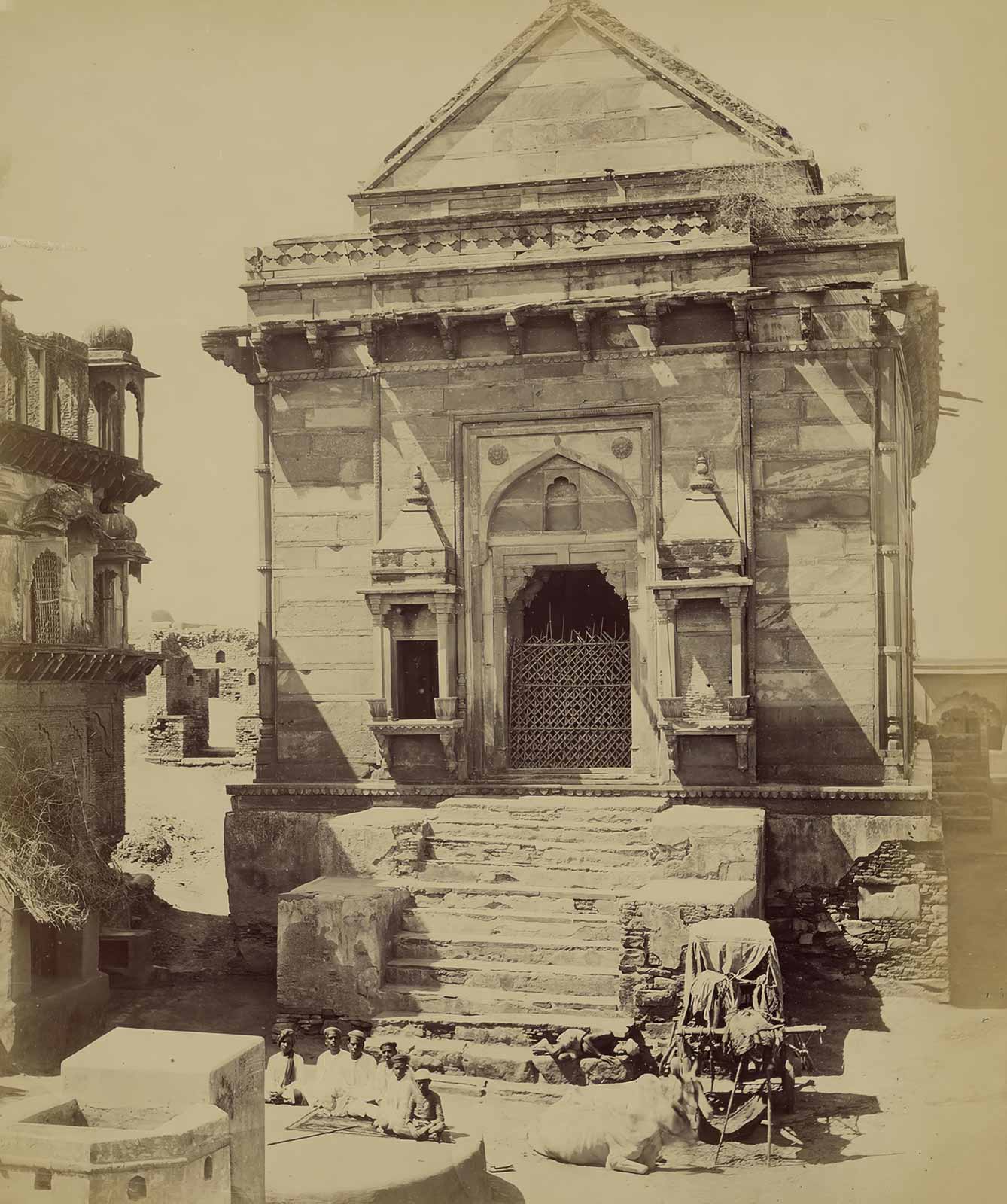
After the time of Kṛṣṇa, many Deities were installed in Vraja by His great-grandson Vajranābha, who was the king of Mathurā. At Govardhana there was a Deity of Kṛṣṇa lifting Govardhana Hill who was known as Gopāla. In modern times, they call Him Nāthajī, and He lives in Nathdwara near Udaipur in Rajasthan. He is worshipped there by the Vallabha sampradāya, but originally that Deity was at Govardhana in a big white temple on top of the hill. At some particular time when the Muslims invaded, the Deity hid Himself away in the jungle near Govardhana Hill. Many years later, when Mādhavendra Purī was doing Govardhana parikramā, he was camped near Govinda-kuṇḍa. On one particular night there, he had a dream where Kṛṣṇa was calling to him, “I’m stuck in the mud, and My body’s dry and burning. I’ve here for so long, so come get Me out of this place.”
He saw in his dream that the Deity was near Govardhana Hill, so in the morning he got the people from Āniyor village and told them about his vision. Because he was such a saintly devotee, they believed in him and came to that spot and moved away the dirt. Sure enough, under a bush buried in the ground, there was the Deity of Gopāla, the lifter of Govardhana Hill. They took the Deity and placed Him on a stone on Govardhana, and that is where they built the temple later. There, they performed the Annakūṭa ceremony every day for one year continuously. During that time, brāhmaṇas were chanting mantras, kīrtana was happening, bhoga was offered etc. Mādhavendra Purī saw that the Deity of Kṛṣṇa was actually eating, but nobody else could see this. Each day, thousands of pots of milk were brought in for bathing the Deity. As word spread, people spontaneously came from all over Vraja. Every day, so many bullock carts full of people would show up.
Sometime later, news came that the Muslim army was coming to break everything in Govardhana, so the villagers took the Deity and hid Him in the house of a brāhmaṇa in a nearby village. Actually, it was a false rumour created by Yogamāyā – there was no army, there was no danger, but Gopāla knew that if He remained on top of Govardhana Hill, when Mahāprabhu came to Vraja, He would not see Him, because He did not want to tread on Girirāja, who is non-different from Kṛṣṇa. When Mahāprabhu arrived in Govardhana, He went to that village and for three days He sat and took darśana of Gopāla, the lifter of Govardhana Hill. A little after, when the coast was clear, Gopāla was returned to His temple.
(Gopāla and his original temple at Jatipura, Govardhana)
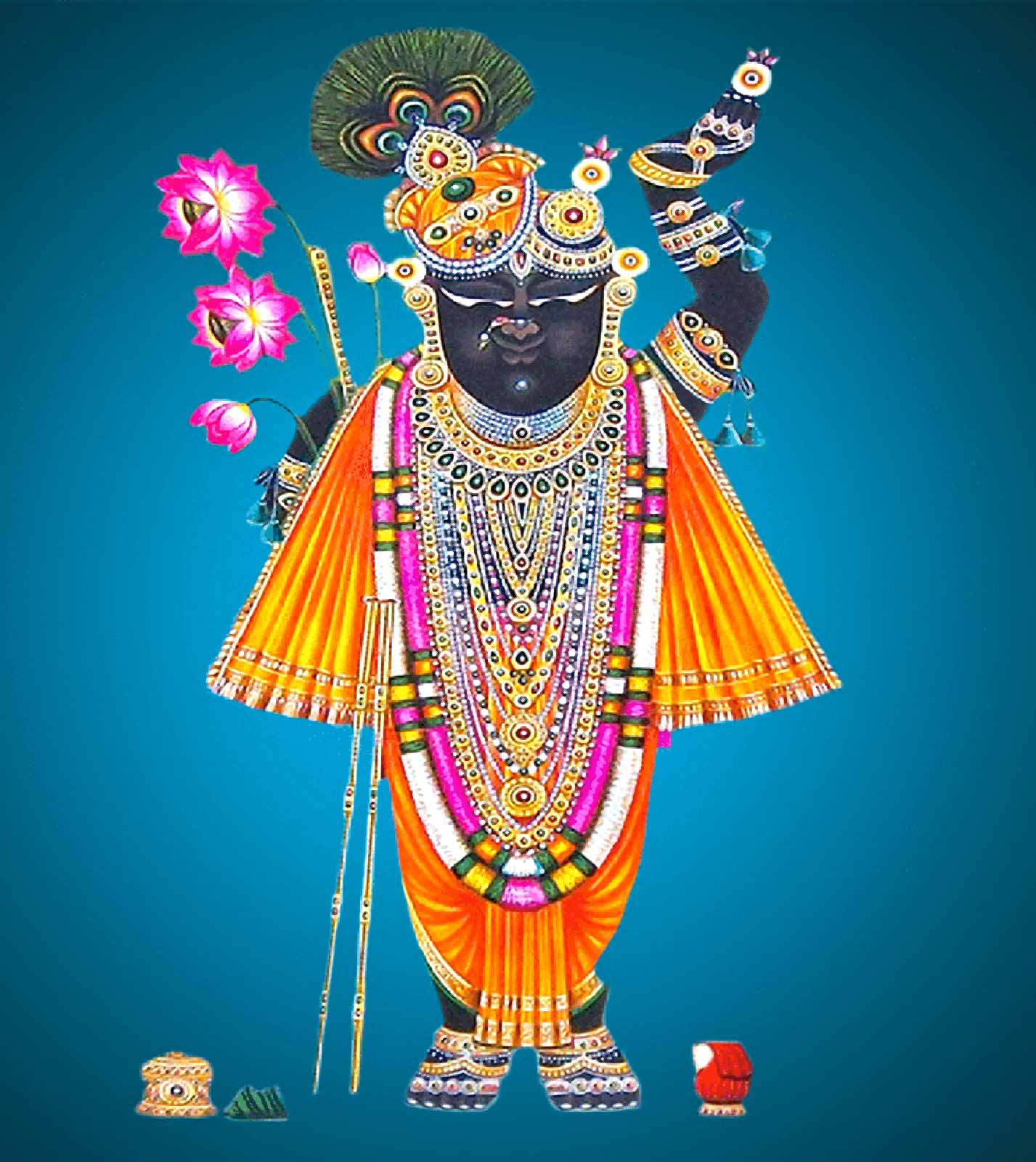
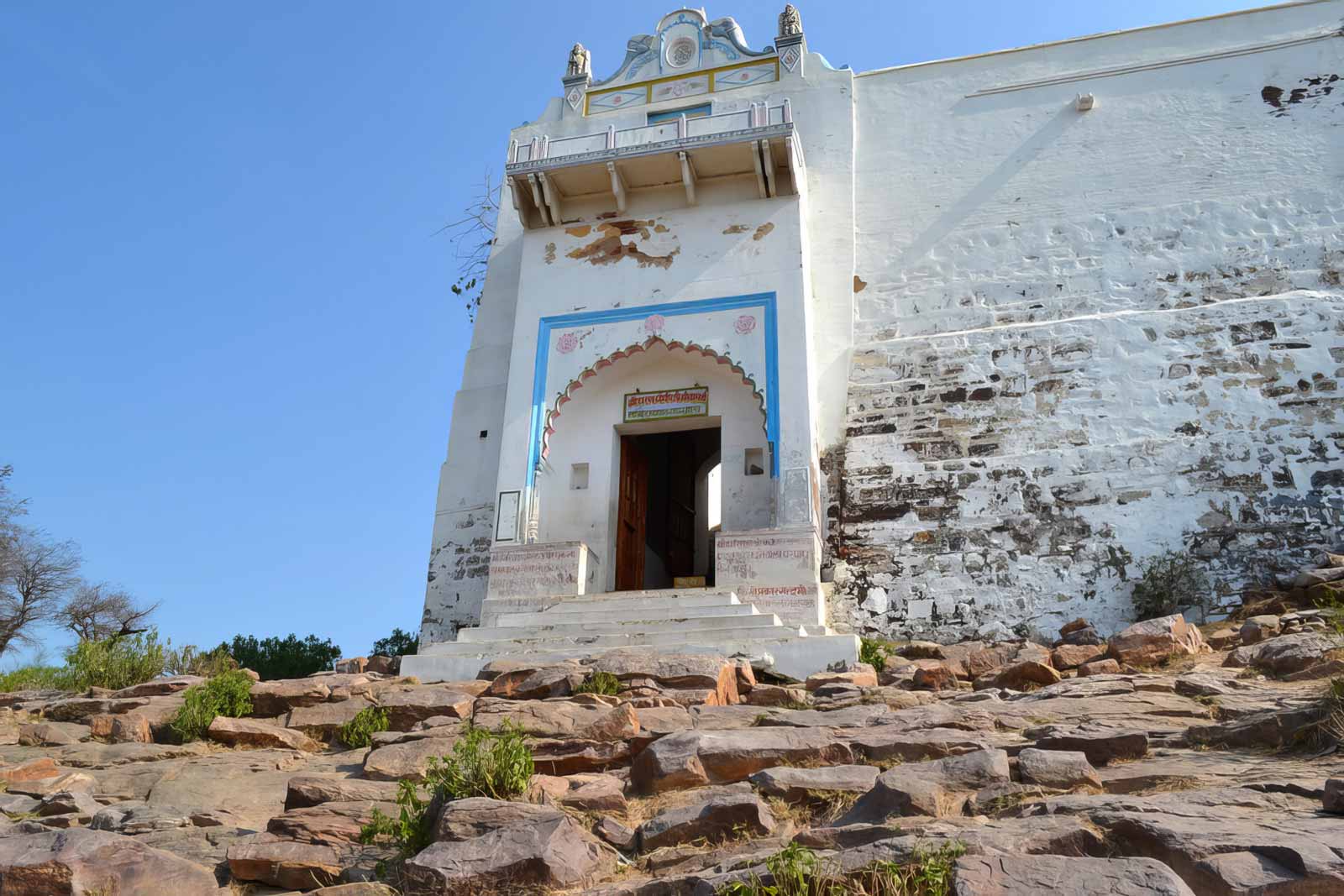
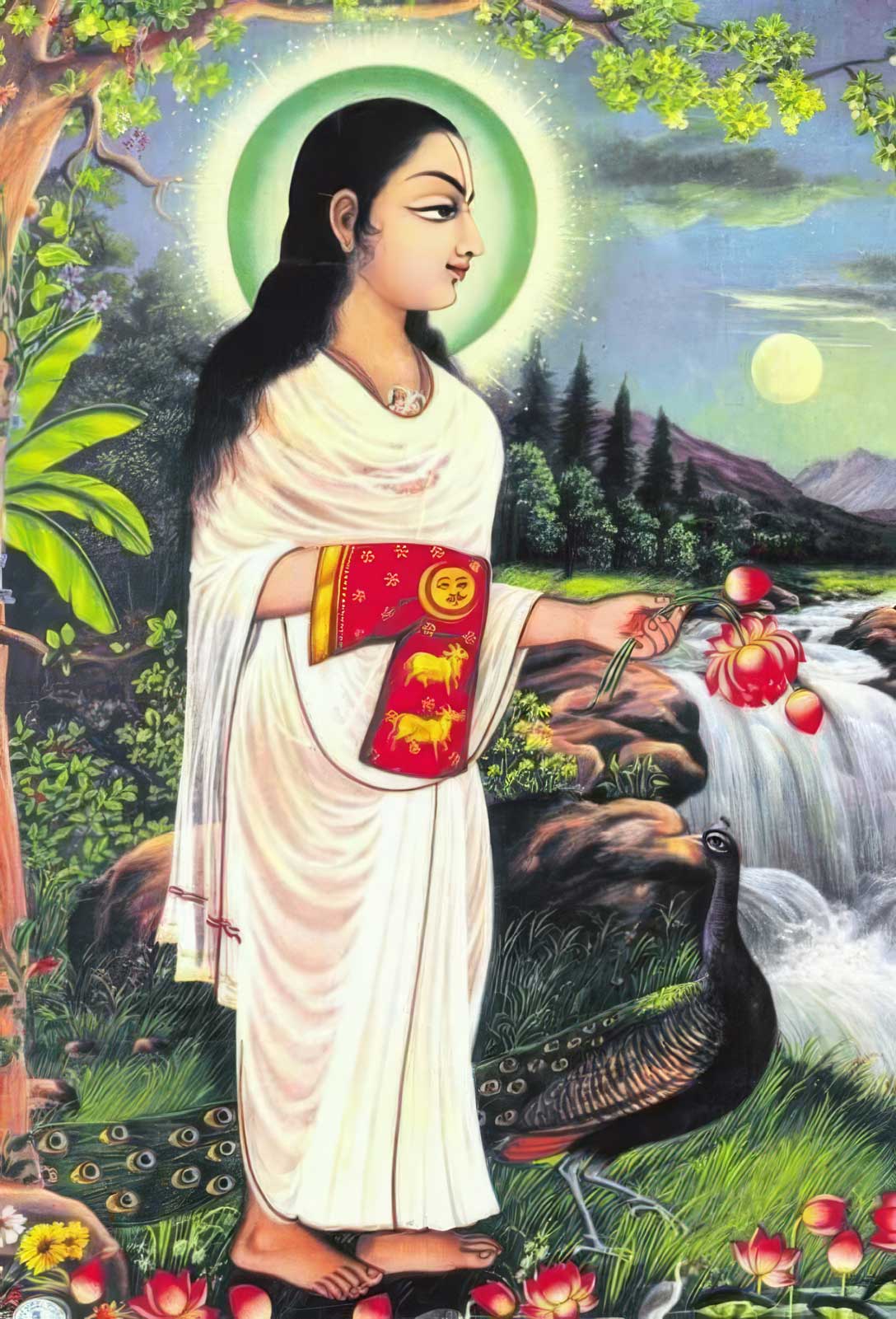
How the Vallabha sampradāya came to worship Gopāla/Śrīnātha is interesting. Vallabhācārya was a great scholar, a very big paṇḍita, and he first met Mahāprabhu in Prayāga. He became very attracted to Mahāprabhu and His teachings, and eventually came to Purī to get Mahāprabhu’s association. But because Vallabha was very proud, Mahāprabhu and His devotees didn’t pay him so much attention. In fact, Mahāprabhu called Vallabha a prostitute because he did not accept the paramparā of the Bhāgavatam. He rejected the commentary of Śrīdhara Svāmī, so Mahāprabhu rejected him. Mahāprabhu told him, “Whoever rejects his svāmī is a prostitute!” There’s a play on words here – svāmī means husband, and if a woman rejects her husband, she is as good as a prostitute. But here, Mahāprabhu was referring to Śrīdhara Svāmī. All of Mahāprabhu’s associates did not want to talk to Vallabhācārya, did not want to eat with him – nothing! Finally, he latched on to Gadādhara Paṇḍita and said, “You please give me dīkṣā.” Then Gadādhara gave him dīkṣā and lost all his mantra-śakti. Of course, this is a līlā. But later, Gadādhara reported back to Mahāprabhu, “Why have I lost my mantra–śakti?”
Mahāprabhu replied, “Because you gave your mantra to an unqualified person and everything is wasted.” In other words, Gadādhara lost his mantra-śakti because he gave initiation to Vallabhācārya. Then Gadādhara asked Mahāprabhu, “Can You give me re-initiation?”
Mahāprabhu told him, “No, no. Your guru is Puṇḍarīka Vidyānidhi. He is coming to Jagannātha Purī in one or two months. He will give you the mantra again.” This story is narrated in Caitanya-bhāgavata.
Previously, Vallabhacarya had been more attracted to the worship of Bala-Gopāla, Kṛṣṇa as a small child, but after meeting Mahāprabhu and Gadādhara Paṇḍita, he became interested in mādhurya-līlā. Mahāprabhu told him “If you want to know mādhurya-rasa, you have to worship Gopāla as a cowherd boy in Vṛndāvana – you have to worship that Kṛṣṇa.” So eventually, he came to Vraja and became a very prominent person in Govardhana and established his cult there.
One friend of mine, Gopāla Ghosh, who was a scholar of Gauḍīya Vaiṣṇavism at the Vṛndāvana Research Institute told me that at that time, the Gauḍīyas were worshipping Gopāla directly, while Vallabha and his followers were supporting the worship financially – sending bhoga and all these things. After Vallabhācārya expired, his sons, Viṭṭhalanātha and Gopīnātha, took charge of his sampradāya, but they decided that since they were paying for the temple, the pūjā etc, they should also be the one’s worshipping the Deity. The Gauḍīya Vaiṣṇavas who worshipped Gopāla were all bābājīs and lived in some small thatched cottages near the temple. So one day, while the Gauḍīyas were worshipping in the temple, the Vallabhas set fire to their houses, then ran and told them the news. Immediately, the Gauḍīyas left the temple to put out the fires, and when they came back, the Vallabhas had locked the temple doors and put guṇḍas outside to stop them from entering again. So actually, they stole the Deity. Later, out of fear of Aurangzeb, they grabbed the Deity and went to Udaipur which was under the Mewar kings. The kings of Mewar never surrendered to the Moghuls, so that area was an independent Hindu kingdom. At that time, there was total war between Southern Rajasthan and the Mughals, and the people there were not going back and forth very often. There wasn’t much communication because there was a huge desert in-between, and the desert itself was a battleground. Some tales about Mahāprabhu trickled through to Rajasthan, but the sons of Vallabha fabricated stories of how Gopāla was discovered, who discovered him, how he went to Nathdwara etc. They began to refer to Vallabhācārya as ‘Mahāprabhu-jī’ and would ask people, “You have heard of Mahāprabhu?”
“Oh yes, we have heard some stories. He was a saint from Bengal.”
“No, no, Mahāprabhu-jī was our father. This Deity appeared to him in a dream.” Then they would tell the story of Mādhavendra Purī and replace him with Vallabha, and various līlās of Mahāprabhu, would also be attributed to Vallabhācārya. “Our father went to Jhārikhaṇḍa, and he made the tigers dance!”
I have been to Nathdwara for darśana a couple of times. The first time I went, I wanted to know what the Vallabhas say about our Mahāprabhu, so I took off my tilaka and just played dumb. I approached one of their paṇḍitas, pointed to a painting of Vallabhācārya and said, “Oh, who is this? Is this Vallabhācārya?”
He said, “Yes, that is our Vallabhācārya Mahāprabhu-jī.”
Then I said, “Someone told me he was making the tigers dance?”
“Not just tigers – elephants also!”
Then I told him, “There was this other fellow in India, some ‘Caitanya’ something?”
“Yes, yes – Kṛṣṇa Caitanya.”
“Did He meet with Vallabhācārya?”
“Oh, yes, Caitanya gave great respect to our Vallabhācārya Mahāprabhu-jī. Caitanya had written a commentary on the Bhāgavatam, but after hearing Vallabhācārya’s commentary, He threw His own commentary into the Gaṅgā and told Vallabhācārya, ‘Your Bhāgavata commentary is everything. Mine is nothing!’”
After that, I thought, “Okay, I’ve heard enough!”
In fact, Śrīla Prabhupāda had said, “They stole that Deity! They stole Him from our sampradāya” and he told Girirāja Mahārāja in Bombay, “If Iskcon ever gets power in India, file a case against the Vallabhas and sue them in the court to bring back our Deity.” When we told that to Śrīla Śrīdhara Mahārāja, he said, “Yes, the Gauḍīya Maṭha did the same thing. One case was there for fifty years.” They were trying to fight the case in the courts to bring the Deity back to the Gauḍīyas. That is because, in one sense, our main paramparā Deity is that Gopāla, the lifter of Govardhana Hill.
Mahāprabhu and Govardhana
In Purī, Mahāprabhu, in the mood of a gopī, ran to Caṭaka Parvata thinking it to be Govardhana. What we learn from this is that if we desire to attain ultimate perfection, we must have attraction to Govardhana. And also, if you want to go in that direction, you have to go through Caitanya Mahāprabhu. That is why, before his prayers to Govardhana in his Stavāvalī, Raghunātha Dāsa Gosvāmī begins his book with the Gaurāṅga Stava Kalpa-vṛkṣa. He first approaches the lotus feet of Śrī Caitanya Mahāprabhu:
*gatiṁ dṛṣṭvā yasya pramada-gaja-varye’khila-janā
mukhaṁ ca śrī-candropari dadhati thūtkāra-nivaham
sva-kāntyā yaḥ svarṇācalam adharayac chīdhu ca vacas-
taraṅgair gaurāṅgo hṛdaya udayan mām madayati*
All those who observe His gait rebuke the movements of the best of intoxicated elephants, and upon seeing His face, they condemn the moon above. His own splendour is like that of a golden mountain and His words are like waves of nectar. Thus, the appearance of Śrī Gaurāṅga which arises within my heart, maddens me. (Śrī *Gaurāṅga Stava Kalpa-vṛkṣa *1)
Without approaching Mahāprabhu, no one has access to Rādhā-Kṛṣṇa, no one has access to Govardhana Hill. So many people say, “What is the difference between you and so many other Vaiṣṇava sampradāyas?” The primary difference is that we accept Caitanya Mahāprabhu as He is, as rasarāja-mahābhāva – others don’t! Therefore, they don’t actually have a place at Rādhā-kuṇḍa or Govardhana. Everyone else is borrowing, like beggars outside a bank. All the sampradāyas ran to Vṛndāvana during the heyday of its renaissance. The vaikuṇṭha-bhaktas came to borrow the prestige of Vṛndāvana, but they have no rightful claim there. Kavirāja Gosvāmī condemns anyone who tries to worship Rādhā-Kṛṣṇa without accepting the lotus feet of Caitanya Mahāprabhu. A number of scholars have shown that many of these groups in Vṛndāvana have post-dated some of their scriptures so that they can say, “No, no – mādhurya-rasa was already there in our sampradāya!” It’s all a scam! We must approach Girirāja through Mahāprabhu – He is not any less than that same Govardhana.
Girirāja Mahārāja ki jaya!

Related Articles and Books
📚Pilgrimage With Swami Narasiṅgha Series Index 📚 Prema Dhāma Deva Stotram with the Narasiṅgha Sevaka Commentary Series Index 📖 In Search of the Ultimate Goal of Life by Śrīla A.C. Bhaktivedānta Swami Prabhupāda 📖 Śrī Dāmodara Kathā by Śrīla Bhakti Gaurava Narasiṅgha Mahārāja 📖 Prabhupāda Vijaya by Śrīla Bhakti Gaurava Narasiṅgha Mahārāja The Ontological Position of Śrī Śrī Rādhā-Govinda by Śrīla B.R. Śrīdhara Deva Gosvāmī Śrī Govardhana Pūjā by Śrīla Bhakti Rakṣaka Śrīdhara Deva Gosvāmī The Vṛndāvana Express and the Navadvīpa Special by Śrīla Bhakti Rakṣaka Śrīdhara Deva Gosvāmī Vraja Bhāva by Śrīla Bhakti Gaurava Narasiṅgha Mahārāja The Worship of Govardhana by Śrīla Bhakti Gaurava Narasiṅgha Mahārāja Dāsa Gosvāmī and the Unique Position of Govardhana by Śrīla Bhakti Gaurava Narasiṅgha Mahārāja Ācāryas at Śrī Śrī Rādhā-Dāmodara Temple, Vṛndāvana by Śrīla Bhakti Gaurava Narasiṅgha Mahārāja Pilgrimage to Vṛndāvana-dhāma by Śrīla Bhakti Gaurava Narasiṅgha Mahārāja The Appearance of Rādhā-kuṇḍa by Śrīla Bhakti Gaurava Narasiṅgha Mahārāja
Further Reading
Rādhā-kuṇḍa and Śyāma-kuṇḍa by Śrīla Bhaktivinoda Ṭhākura Śrī Śrī Raghunātha Dāsa Gosvāmī by Śrīla Bhaktivinoda Ṭhākura Vṛndāvana by Śrīla Bhaktivinoda Ṭhākura