Pilgrimage with Swami Narasiṅgha – Part 9 Rādhā-kuṇḍa & Śyāma-kuṇḍa
Pilgrimage with Swami Narasiṅgha – Part 9: Rādhā-kuṇḍa & Śyāma-kuṇḍa
For the upcoming appearance day of Rādhā-kuṇḍa and Śyāma-kuṇḍa on Caitra Pūrṇimā, we present the next instalment of our Pilgrimage With Swami Narasiṅgha series. This article, adapted from several talks by Narasiṅgha Mahārāja, explores some of the pastimes, places, and ontology of Rādhā-kuṇḍa and Śyāma-kuṇḍa, and also addresses questions about bathing in and residing at Rādhā-kuṇḍa.
Articles in this series:
Pilgrimage With Swami Narasiṅgha – Part 1: Imlitalā Pilgrimage With Swami Narasiṅgha – Part 2: Śrī Śrī Rādhā-Dāmodara Temple Pilgrimage With Swami Narasiṅgha – Part 3: Śrī Śrī Rādhā-Govinda Mandira Pilgrimage With Swami Narasiṅgha – Part 4: Kurukṣetra Pilgrimage With Swami Narasiṅgha – Part 5: Śrī Śrī Rādhā-Ramaṇa Temple Pilgrimage With Swami Narasiṅgha – Part 6: Śrī Śrī Rādhā-Madana-mohana Temple Pilgrimage with Swami Narasiṅgha – Part 7: Keśī Ghāṭa Pilgrimage with Swami Narasiṅgha – Part 8: Govardhana Pilgrimage with Swami Narasiṅgha – Part 9: Rādhā-kuṇḍa & Śyāma-kuṇḍa Pilgrimage with Swami Narasiṅgha – Part 10: Kāliya Ghāṭa
The Appearance of Śyāma-kuṇḍa and Rādha-kuṇḍa
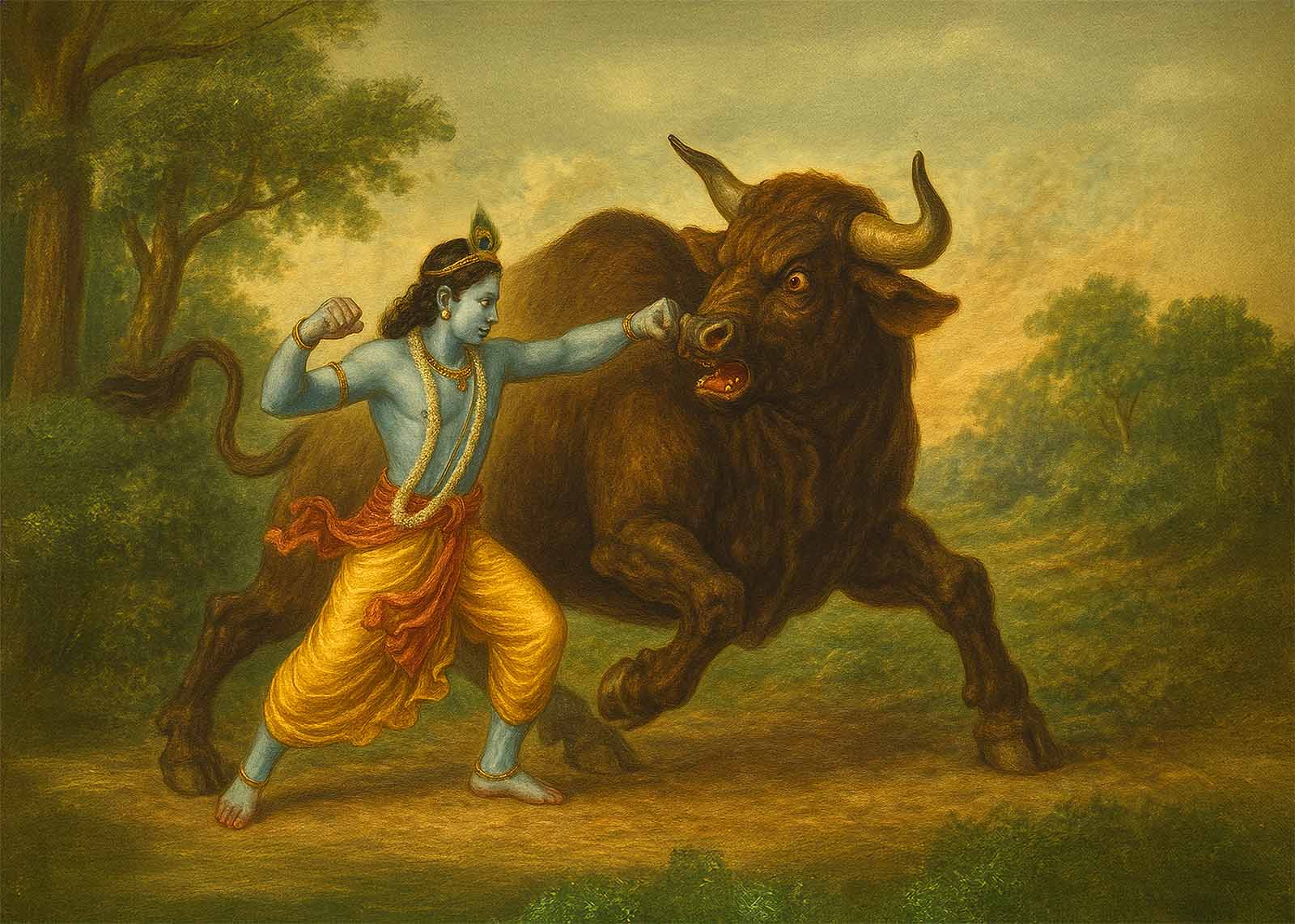
In Vraja, Kṛṣṇa killed a demon named Ariṣṭāsura who came in the form of a bull, and after killing him, Kṛṣṇa wanted to resume His pastimes with Rādhārāṇī and the gopīs, but they rejected Him. They told Him, ” You have pāpa, sin, because You killed a bull, and the bull represents dharma. Now You are contaminated and it is necessary for You to purify Yourself. You have to perform some prayaścitta, some atonement.” Then they recommended, “You go and bathe in all the holy rivers – the Gaṅgā, Yamunā, Sarasvatī, Kāverī, Sindhu etc. Only then will we play with You again. Otherwise, we won’t touch You because You are a third class man!”
Then Kṛṣṇa said, “Yes, but I don’t have time to go to so many places and neither do I like to leave Vṛndāvana.” So, Kṛṣṇa took His foot and just made a hole in the ground with His heel and requested all the holy rivers to please come, and one by one, all the main holy rivers came in person, bowed before Kṛṣṇa and entered that hole that He had made with His foot. Then Kṛṣṇa took His bath.
After that, He extended an invitation to the gopīs for water pastimes and requested them, “Please come and we will play in My kuṇḍa – Śyāma-kuṇḍa.”
But Śrīmatī Rādhārāṇī said, “No, no. This is a dirty place now, because You killed a bull and took Your bath here. How can we enter this water? This water contains the sin of Your killing. How will we have pastimes in this water?”
Then some argument started and Kṛṣṇa gave a challenge. “Then what will you do? Where you will bathe? It’s very hot now. Which way will you enjoy water pastimes when you have no kuṇḍa?”
(Rādhārani and the gopīs dig Rādhā-kuṇḍa)

“We will make our own kuṇḍa!” the gopīs told Him. Then Kṛṣṇa stood back with His friends, as Rādhārāṇī and the gopīs began to dig the ground with their bangles, with sticks etc. They only made a small hole, and they were all sweating, and their cloth was falling this way and that way, but no water was coming up! Rādhārāṇī and Her friends became totally frustrated – they could not succeed in digging a kuṇḍa. Finally, they made a line all the way to Mānasī Gaṅgā and started filling pots with water from there and, passing them down the line, they started to fill their small kuṇḍa. Again, all the personified holy rivers appeared before the Lord and asked Him, “Please allow us to make this kuṇḍa.” Then all the rivers entered the gopī’s kuṇḍa and the two kuṇḍas were there, side by side. In this way, in Kṛṣṇa’s līlā, both Rādhā-kuṇḍa and Śyāma-kuṇḍa appeared in the course of the day’s drama.
Some people say that the water ran from Śyāma-kuṇḍa and filled up Rādhā-kuṇḍa. Others say that when the waters filled up Rādhā-kuṇḍa, then they both overflowed and joined together. At any rate, there may be some variation according to different śāstras, but Kṛṣṇa’s pastimes are not bound by any one variation. However, the general idea is that first, there was Śyāma-kuṇḍa and then Rādhā-kuṇḍa manifested. Actually Rādhā-kuṇḍa and Śyāma-kuṇḍa are eternally manifest. Just as Kṛṣṇa has His appearance in this world, but He is actually aja, unborn. Similarly, Rādhā-kuṇḍa and Śyāma-kuṇḍa eternally exist. *****
Note: Contrary to popular belief, the appearance of Rādhā-kuṇḍa and Śyāma-kuṇḍa is not on Bahulāṣṭamī in Kārttika, but occurs on the full moon of the month of Caitra (March/April). This is explained by Śrīla Jīva Gosvāmī Prabhu in his Laghu Vaiṣṇava Toṣaṇī – **ekādaśāsya caitra-paurṇamāsyaṁ āriṣṭa-vadhaḥ *(‘Āriṣṭāsura was slain on the full moon of the month of Caitra when the Lord was eleven years old.’) Śrī Jīva explains in his Gopāla Campu that Rādhā-kuṇḍa and Śyāma-kuṇḍa appeared on the same day as the killing of Ariṣṭāsura, and on the evening of that day, Śrī Kṛṣṇa and the gopīs began their vasanta-rasa (rāsa-līlā during the Spring season). The spring season occurs between mid-February till the end of April. Thus, the month of Kārttika could not be the appearance of Rādhā-kuṇḍa. Another point is that Kṛṣṇa and the gopīs performed their jala-krīḍa (water pastimes) at this time because of the summer heat. Bahulāṣṭamī occurs in Kārttika, whose weather is not conducive for the water pastimes of the Lord. Some devotees also claim that Bahulāṣṭamī was the day that Mahāprabhu rediscovered Rādhā-kuṇḍa in Āriṭ-grāma (Cc. Madhya-līlā 18), but we know that Mahāprabhu arrived in Vraja at the end of the month of Kārttika, so this also cannot be correct. Hence, Caitra Pūrṇimā is the appearance day of Rādhā-kuṇḍa and Śyāma-kuṇḍa.
Rādhā-kuṇḍa – The Place of Exclusive Mādhurya-rasa
The circle of mādhurya-rasa in kṛṣṇa-līlā is actually very limited, in the sense that only the most qualified have any access to that. The more the Lord’s pastimes are exalted in terms of intimacy, the fewer personalities are found there. The rāsa-līlā in Vṛndāvana is a general rasa, where all the gopīs participate – there are millions there. But at Govardhana, the rāsa-līlā is for a more select group. Then there is the rāsa-līlā at Rādhā-kuṇḍa and that is the most exclusive. That is a very intimate group, a chosen few – it is not for all. At Rādhā-kuṇḍa there are a couple dozen gopīs. The higher the līlā, the fewer the qualified personalities.
Śrīman Mahāprabhu’s Rediscovery of Rādhā-kuṇḍa and Śyāma-kuṇḍa
(Mahāprabhu bathes in Rādhā-kuṇḍa)
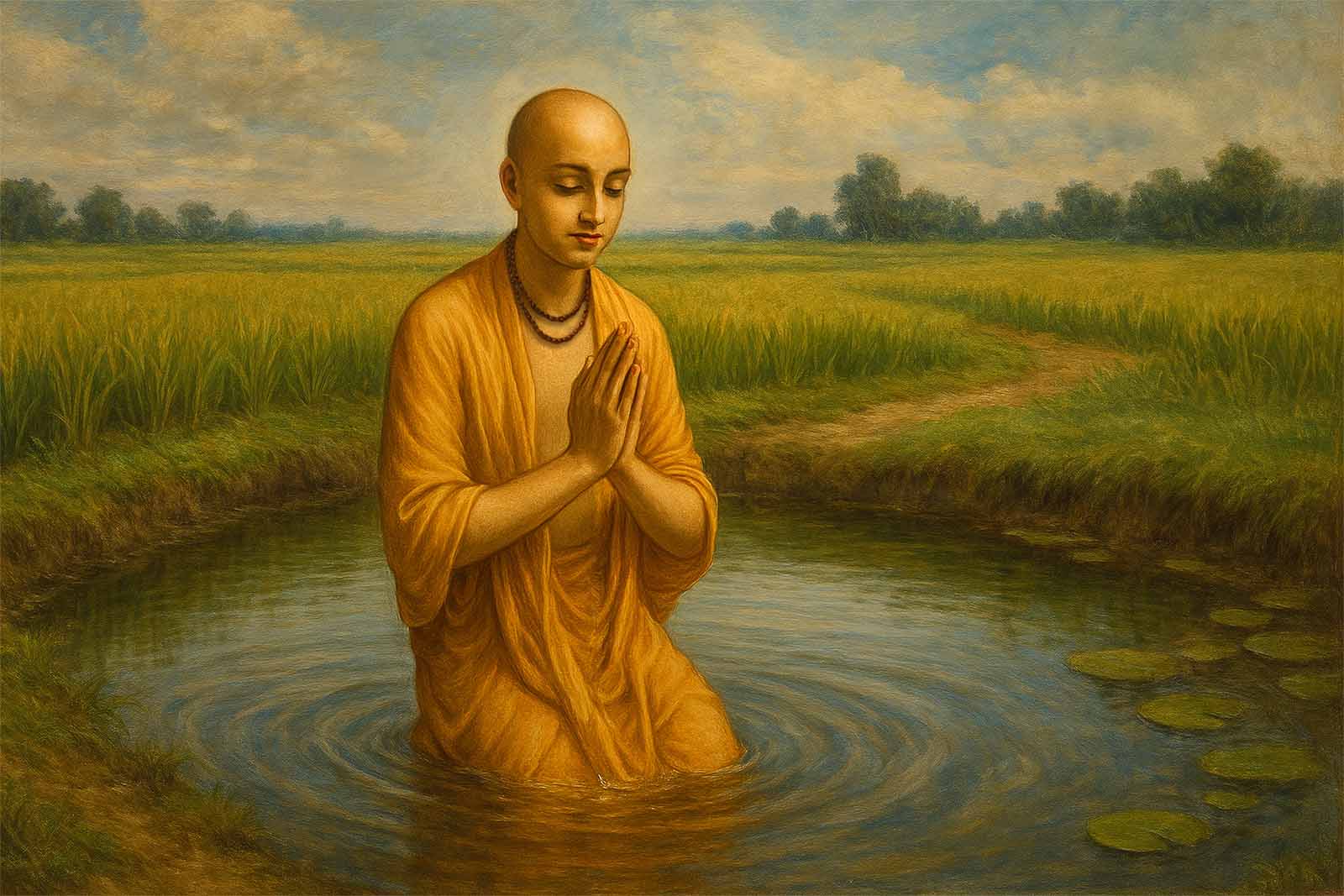
The village where Kṛṣṇa killed Ariṣṭāsura later became known as Āriṭ Grāma, and when Caitanya Mahāprabhu came here, He understood, “Oh, Āriṭ-grāma means Ariṣṭāsura-grāma. So this must be where Kṛṣṇa killed Ariṣṭāsura.” The word ārīṭ comes from the name Ariṣṭa. He inquired from the villagers about Śyāma-kuṇḍa and Rādhā-kuṇḍa, but nobody knew anything. They said, “We don’t know. But there is one place with two small ponds that our grandfathers used to call Syāma-Gaurī.” Syāma means Kṛṣṇa and Gaurī means Rādhārāṇī.
Mahāprabhu went there to see, and as soon as He came in connection with these ponds, then immediately, the symptoms of ecstatic love of Kṛṣṇa manifested in Him. Much to everyone’s amazement, He offered obeisances and immediately took bath there. Those two ponds were not very deep at all – the whole place was just paddy fields and wetlands. After taking bath, Mahāprabhu took some mud from the side of the small ponds and He used it as tilaka. When the village people saw this they were very surprised. They had considered these two ponds to be nothing special. In this way, Rādhā-Govinda Themselves, in the form of Caitanya Mahāprabhu, revealed Their own two sacred places, Śyāma-kuṇḍa and Rādhā-kuṇḍa.
Caitanya Mahāprabhu stayed on the banks of these two ponds for some time. There is a place next to Śyāma-kuṇḍa which is said to be the sitting place of Mahāprabhu. I don’t doubt it – He could have sat there, but He could have also sat somewhere else. Why would He just go and sit down in one place? When we do parikramā of Rādhā-kuṇḍa, we stop in so many places. So if Mahāprabhu was here for the whole day, how can we say that He only stayed in one place? No, He circumambulated the kuṇḍas. Whatever the case, this is said to be Mahāprabhu’s baithak (sitting place), but the Six Gosvāmīs did their bhajana elsewhere. They did not try to go and sit where Caitanya Mahāprabhu sat. Caitanya Mahāprabhu is Kṛṣṇa in the mood of Rādhārāṇī. We are worshipping the mood of Rādhārāṇī in Caitanya Mahāprabhu. In this way, Rūpa, Sanātana, Raghunātha etc. all did their bhajana somewhere else.

We are the worshippers of Caitanya Mahāprabhu. We cannot imitate Him. Actually, Caitanya Mahāprabhu is not the founder of the sampradāya – He is the Deity of the sampradāya, the iṣṭadeva. Caitanya Mahāprabhu is the vipralambha-mūrti, the embodiment of separation of Kṛṣṇa. So, even when coming to Rādhā-kuṇḍa and Śyāma-kuṇḍa, we cannot be forgetful even for a moment of the vipralambha-mūrti. Without the vipralambha–mūrti, no one actually has any legal access or right to come here. Nonetheless, many people come here, but without the direction of the vipralambha-mūrti. Such persons are never appreciated in our sampradāya. Mahāprabhu is the full embodiment of mādhurya-rasa. It is actually not possible to worship Rādhā-Govinda without first worshiping Caitanya Mahāprabhu.
Rādhā-kuṇḍa is where Śrīla Kṛṣṇa Dāsa Kavirāja Gosvāmī wrote the Caitanya-caritāmṛta, the life and teachings of Caitanya Mahāprabhu. We would naturally think, “Oh, if you want to write about Caitanya Mahāprabhu, you should go to Navadvīpa,” but he wrote about Mahāprabhu at Rādhā-kuṇḍa. In this way there is an inner connection.
(Kavirāja Gosvāmī’s Bhajana-kuṭīra)
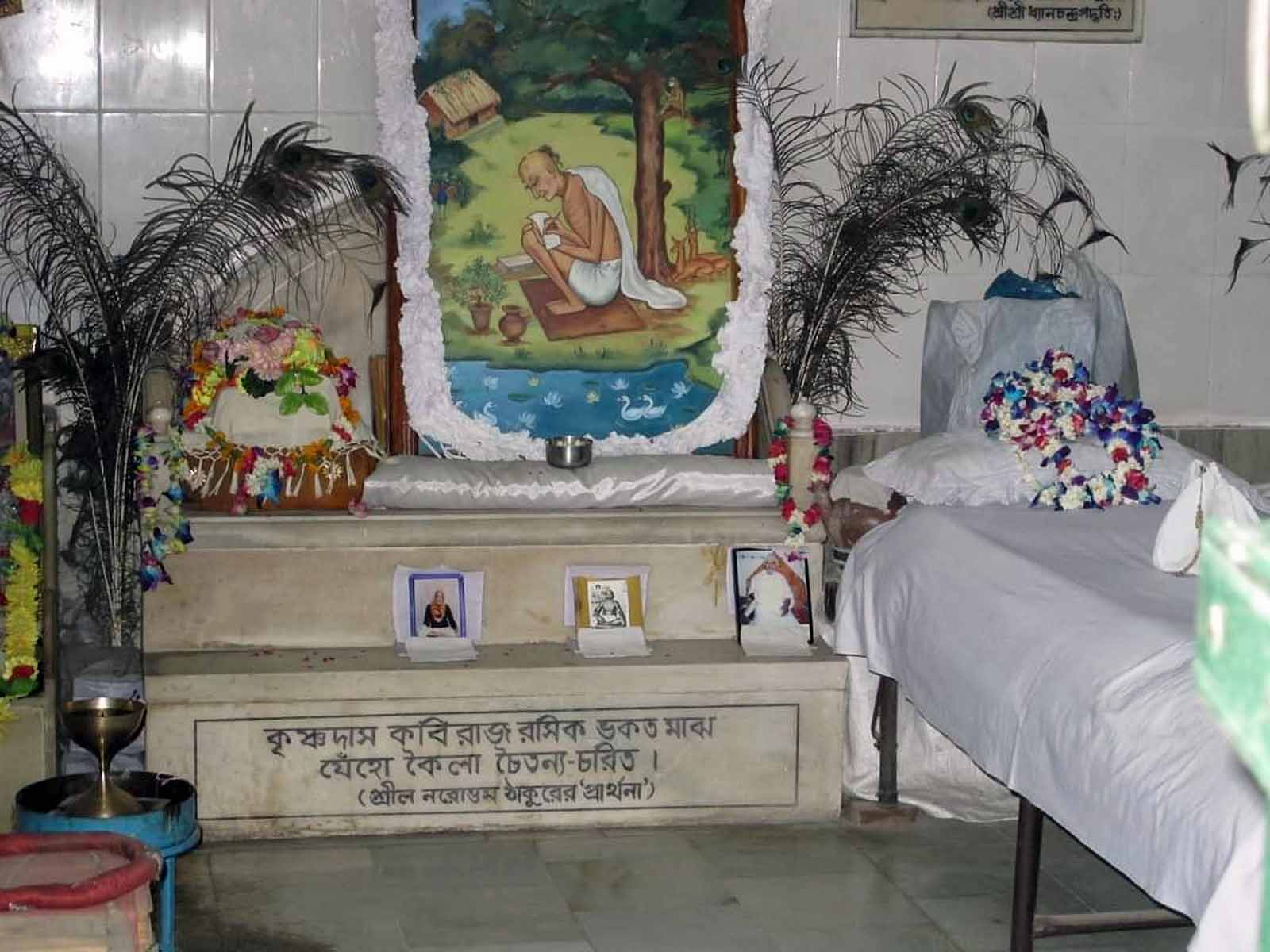
Raghunātha Dāsa Gosvāmī at Rādhā-kuṇḍa
(Raghunātha Dāsa Gosvāmī’s Samādhi & Bhajana-kuṭira)

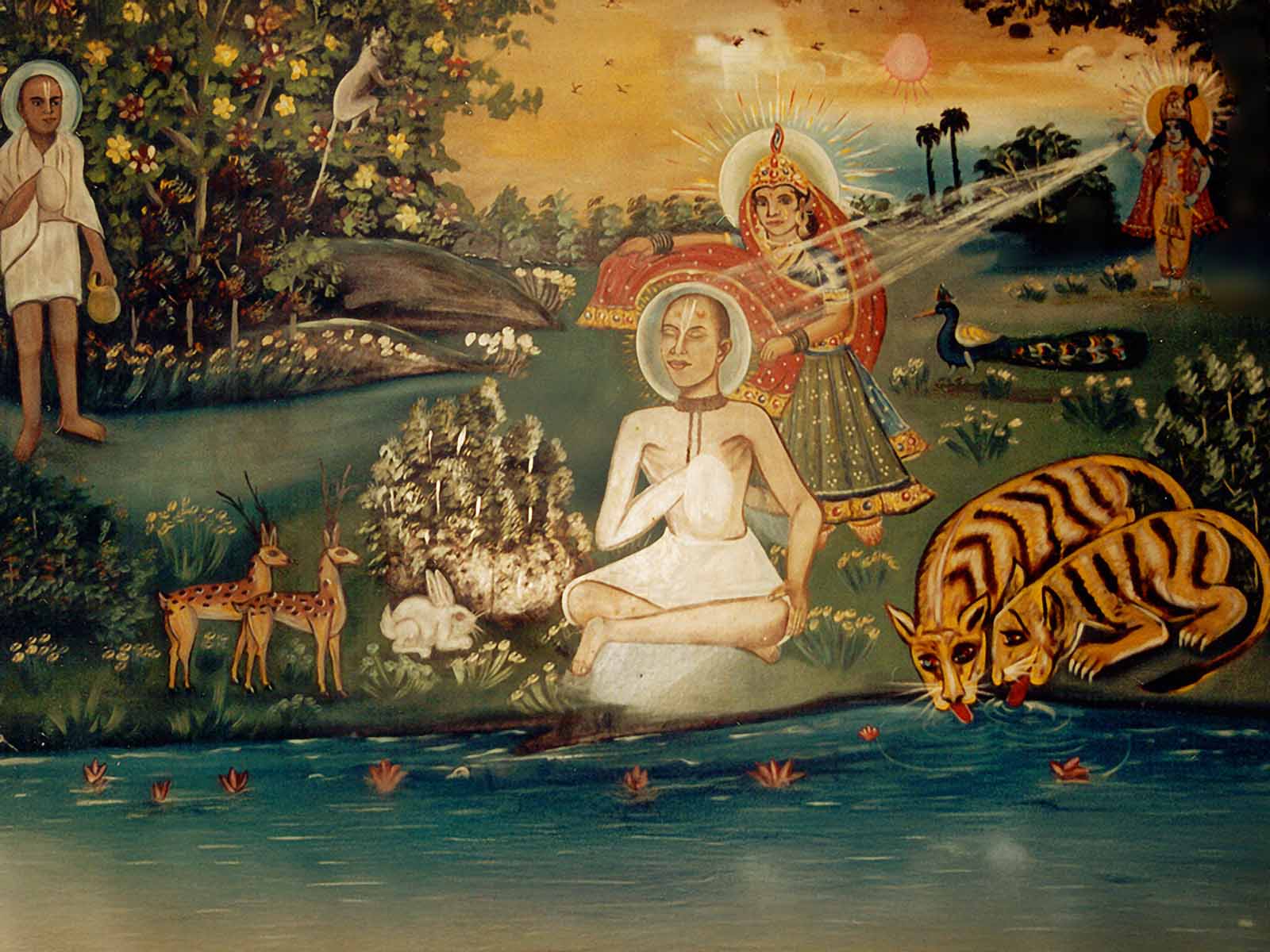
When Raghunātha Dāsa Gosvāmī came to Vṛndāvana, he did his bhajana on the banks or Rādhā-kuṇḍa. He used to just sit under a tree and chant. In those days, Rādhā-kuṇḍa was surrounded by fields and forests and sometimes tigers and other animals would come and drink water there. One time, Sanātana Gosvāmī came to Rādhā-kuṇḍa and at a distance, he saw Raghunātha Dāsa sitting doing bhajana under a tree. As he approached him, he suddenly saw a tiger come out of the bushes – it came right next to Raghunātha Dāsa, drank some water from Rādhā-kuṇḍa, and then went back into the jungle. Raghunātha Dāsa Gosvāmī was so absorbed that he didn’t notice anything. Sanātana saw this and told him later, “I think it’s better that you build a bhajana-kuṭīra here.”
Not long after, another incident happened. Raghunātha Dāsa was sitting in the midday sun chanting intensely. It was the middle of summer, and anyone who has spent summer in Vṛndāvana knows how hot it gets – it can practically melt your eyeballs right out of their sockets! While Raghunātha Dāsa was chanting, Śrīmatī Rādhārāṇī saw that Her devotee was sweating, so She stood behind and held Her veil over him so that he was shielded from the sun. Again, Sanātana Gosvāmī came and he saw how Rādhārāṇī was standing over Raghunātha and perspiring. Later, he told Raghunātha Dāsa Gosvāmī, “This is not good. Today, Śrīmatī Rādhārāṇī, our worshipable Deity, was serving you.” When he told Dāsa Gosvāmī what he had seen, he became very disturbed and felt that he had made a great offence.
Raghunātha Dāsa Gosvāmī was not so concerned for his own safety, but when he heard how he had inconvenienced Rādhārāṇī, that She Herself had served him by taking Her cloth to protect him from the sun’s rays, he became very sad, so he immediately began to make his bhajana-kuṭīra.
Raghunātha Dāsa Gosvāmī Excavates Rādhā-kuṇḍa and Śyāma-kuṇḍa
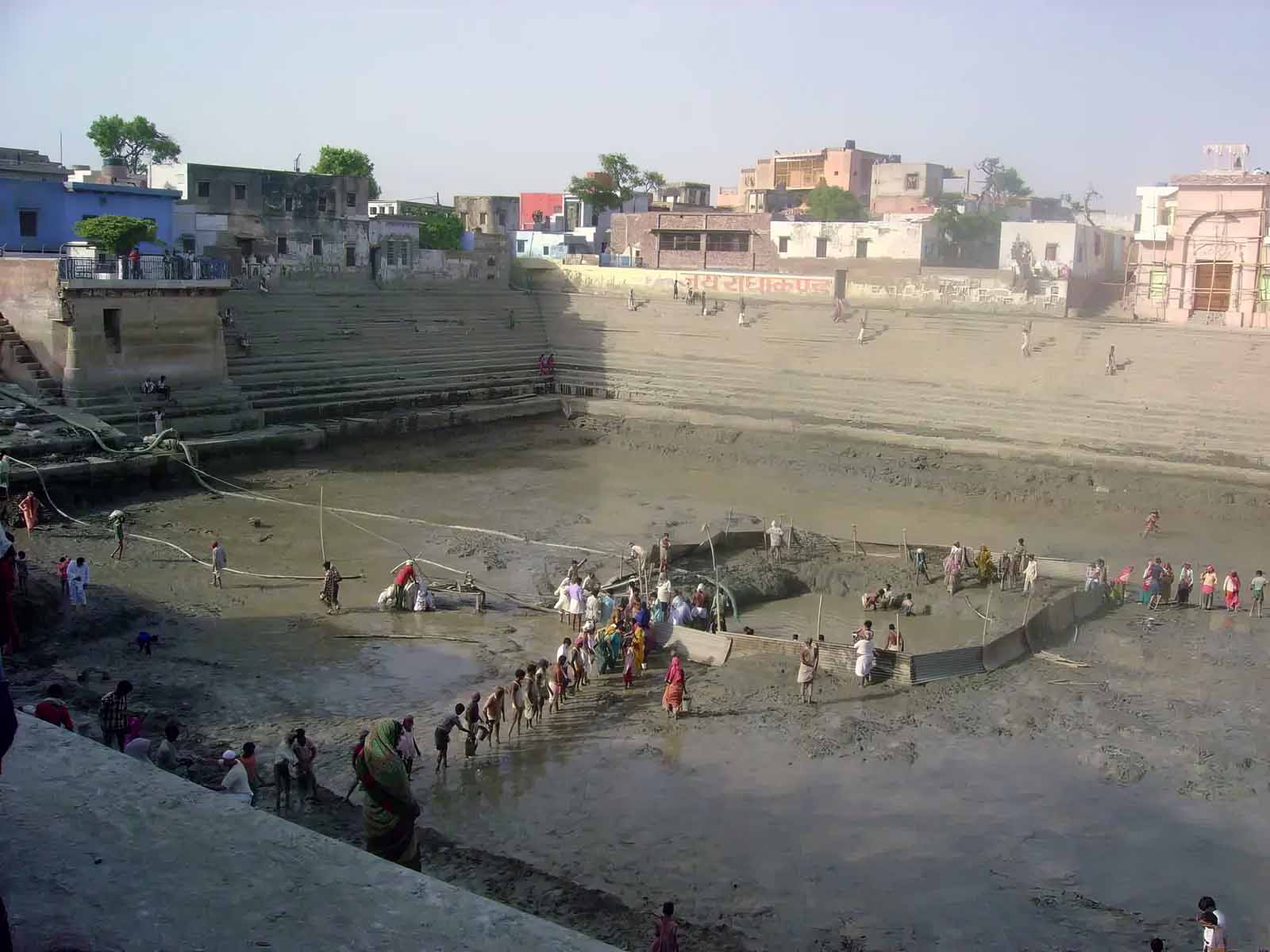
One of the instructions of Mahāprabhu to the Gosvāmīs was to excavate the holy places of Vraja. When Raghunātha Dāsa Gosvāmī came to Rādhā-kuṇḍa, you would have to walk through deep mud and marshes to get to the water in the centre. After some time, with the help of rich merchants and devotees, Raghunātha Dāsa laid stone steps around Rādhā-kuṇḍa and Śyāma-kuṇḍa. Even during hot season, you can only see about five or six steps going down into the water, but there’s actually about fifteen or twenty flights of stairs. I’ve been there when both kuṇḍas were empty. Every twenty years or so, they drain them and you can see how deep they actually are – they are about thirty or forty feet deep! Raghunātha Dāsa gave some form to Rādhā-kuṇḍa and Śyāma-kuṇḍa and he expanded them. The original kuṇḍas which are situated in the middle are actually not very big. You can see them when they are empty.
(Rādhā-kuṇḍa emptied out for cleaning)
The Five Pāṇḍavas
The shape of Rādhā-kuṇḍa is basically a square. That is how you make a kuṇḍa according to vastu-śāstra. But Śyāma-kuṇḍa is not a square – it’s totally irregular. This is because of a dream that Raghunātha Dāsa Gosvāmī had. Now, everybody gets dreams, but when you really have a dream of Krsna, or your guru, you don’t just wake up and think, “Oh, that was a nice dream!” and then go back to sleep or just go on with your day. That type of dream is just a dream. It doesn’t mean anything. No – when you have a real spiritual dream, you wake up and your hair is standing on end like you’re electrified! You’re fully awake and there’s some inspiration there, which will push you forward in your Kṛṣṇa consciousness. You will find that there is so much enthusiasm. So, the Pañca Pāṇḍavas appeared in Raghunātha Dāsa Gosvāmī ‘s dream and told him, “We are doing bhajana in the form of trees on the banks of Śyāma-kuṇḍa, so please don’t disturb us.” At that time, there were five trees growing around the banks of Śyāma-kuṇḍa, so they built the kuṇḍa according to where those trees were, and thus it is a very irregular shape. Eventually, for whatever reason, all those trees left this world, but when I first came here in the 70’s, I remember that there was one tree left. It was very dry and that also left its body a few years ago.
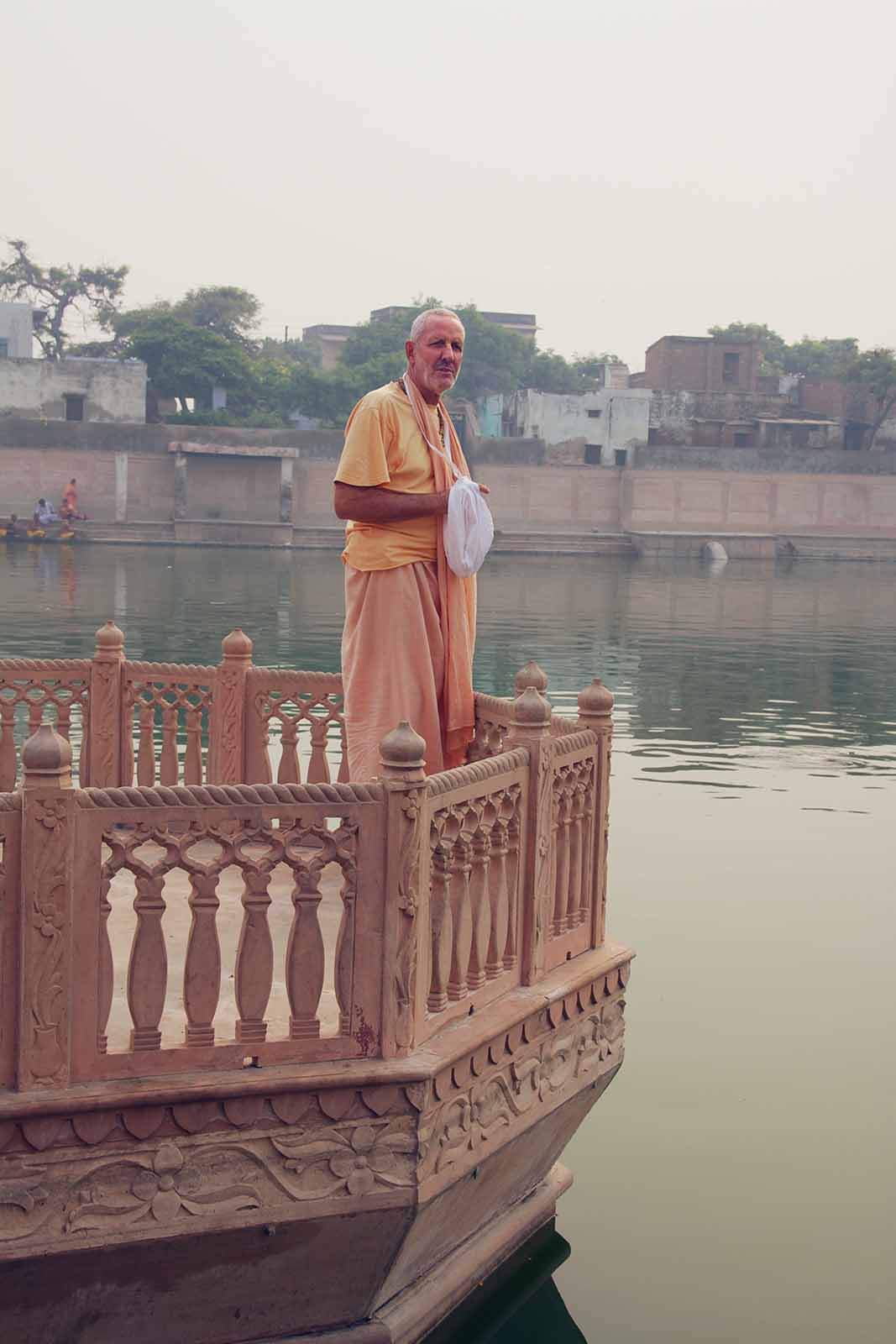
(Narasiṅgha Mahārāja at Śyāma-kuṇḍa)
The Tongue of Govardhana
Why are Rādhā-kuṇḍa and Śyāma-kuṇḍa covered in green algae? Because there are no plants in the water. Actually, the kuṇḍas need plants because they provide oxygen, and when there’s oxygen in the water, the algae doesn’t survive. But now, there’s no oxygen in the water. Also, the locals wash their clothes in Rādhā-kuṇḍa and Śyāma-kuṇḍa, and the soap and the sun breeds this green algae which contaminates everything. It’s environmentally out of balance. What should be done at Rādhā-kuṇḍa is not more and more building and cement work. People should stop using soap completely, and they should plant a thousand water lilies in clay pots and drop them in the kuṇḍas. Then the clay pots will go down to the bottom and the lilies will grow and then oxygen will come – this water could be crystal clear. But it’s very hard to educate people.
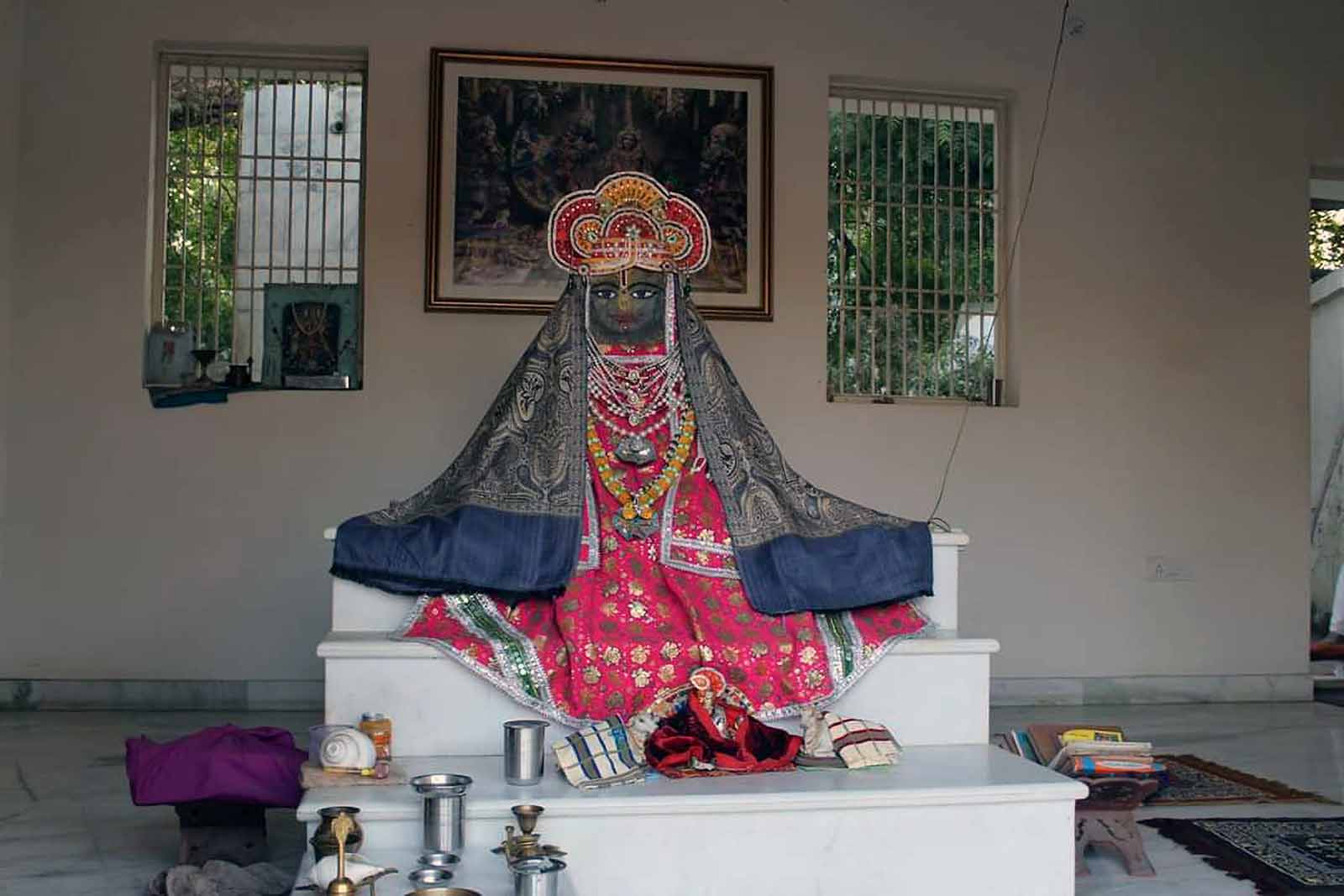
The Gosvāmīs would take a sacred bath in Rādhā-kuṇḍa or Śyāma-kuṇḍa, but they never used it for daily cleaning and washing. For that, Raghunātha Dāsa wanted to make a well, so he excavated an old well which was on the parikramā-mārga. That old well was actually there from Kṛṣṇa’s time and was known as Gopī-kūpa. That’s where the gopīs would draw water from to quench Kṛṣṇa’s thirst during the rāsa dance. When the excavators were digging the well, they hit a stone and blood suddenly began pouring out of it. All the workers became afraid and reported it to Raghunātha Dāsa Gosvāmī and he instructed them to stop digging that day.
When Raghunātha slept that night, he had a dream of Govardhana who told him, “Today your men cut My tongue!” Actually, Śyāma-kuṇḍa and Rādhā-kuṇḍa are considered to be the eyes of Govardhana, and the tongue is just below the eyes. The next day, the diggers went inside the well and carefully dug that govardhana-śilā out of the mud. He was placed in a small temple and has been worshipped there ever since. That well, Gopī-kūpa, was then closed and Dāsa Gosvāmī made another well for bathing and washing.
Lalitā-kuṇḍa and Śrī Jīva Gosvāmī’s Bhajana Kuṭīra

Next to Śyāma-kuṇḍa there is Lalitā-kuṇḍa. That is the kuṇḍa of Lalitā Devī, one of the aṣṭa-sakhīs, the confidential gopī-friends of Rādhārāṇī. Actually, all the aṣṭa-sakhīs have their kuṇḍas around Rādhā-kuṇḍa and Śyāma-kuṇḍa, but the only one that is manifest to our eyes is Lalitā-kuṇḍa.
Śrī Jīva Gosvāmī’s bhajana-kuṭīra is between Śyāma-kuṇḍa and Lalitā-kuṇḍa. It is said that Jīva Gosvāmī used to travel around Vraja with small Deities of Rādhā-Dāmodara. Those Deities are there in that temple.
Jāhnavā Devī’s Sitting Place
(Jāhnavā Devī’s Sitting Place & Narasiṅgha Mahārāja)


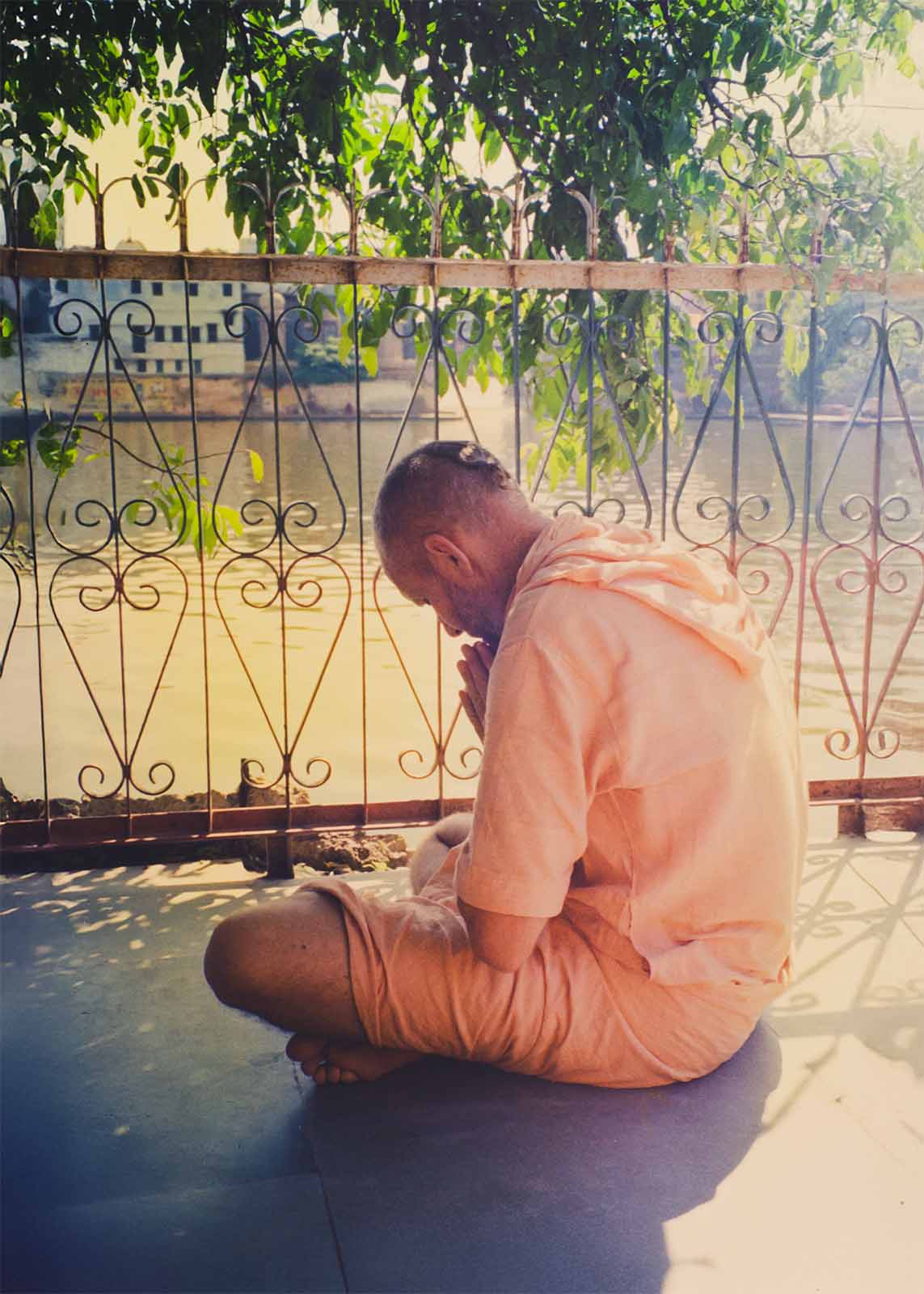
Near to Raghunātha Dāsa Gosvāmī’s bhajana-kuṭīra and samādhi is the sitting place of Jāhnavā Devī, the wife of Nityānanda Prabhu. In kṛṣṇa-līlā, she is Anaṅga Mañjarī, the younger sister of Śrīmatī Rādhārāṇī. Jāhnavā Devī was the leader of the Vaiṣṇava community in Bengal and when she came to Vṛndāvana, she took darśana of the main Deities there and later arranged for the Deity of Rādhārāṇī to be made and placed alongside Gopīnātha. When she came to Rādhā-kuṇḍa, she sat here because that place is actually Anaṅga Mañjarī Kuñja, the place of Anaṅga Mañjarī. According to the Gosvāmī śāstra, there is a crystal bridge which extends from there to Lalitā-kuṇḍa. Of course, we cannot see that with our fleshy eye, but those with the eyes to see can take darśana of that bridge and much more.
The Boundary Between Radha-kuṇḍa and Śyāma-kuṇḍa
(Old photo of Rādhā-kuṇḍa & Śyāma-kuṇḍa boundary)

Once, Śrīla Sarasvatī Ṭhākura gave a lecture at the boundary between Rādhā-kuṇḍa and Śyāma-kuṇḍa. He was not discussing aṣṭa-kālīya-līlā, the eight divisions of kṛṣṇa-līlā over the twenty-four hour period. He was discussing the Upaniṣads – what is the standard of self-realisation, What is the standing of Brahman, What is contrast to this material world etc. Some members of the bābājī section attended his discourse and they protested, “What is this? He’s speaking on Upaniṣads here at Rādhā-kuṇḍa? He’s not speaking about aṣṭa-kālīya-līlā?” and they left. Sarasvatī Ṭhākura then commented to his disciples, “They do not live in Rādhā-kuṇḍa. They live in Naraka-kuṇḍa.” Naraka-kuṇḍa means hell. They live in the kuṇḍa of hell, not in the kuṇḍa of Śrīmatī Rādhārāṇī.
(Old photo of Rādhā-kuṇḍa & Śyāma-kuṇḍa boundary)

This boundary is also where Śrīla Prabhupāda received the instruction from Śrīla Bhaktisiddhānta Sarasvatī Ṭhākura that, “If you ever get money, print books!” At the most sacred place in the universe, this place of the most intimate līlās of the Divine Couple is where Prabhupāda received this instruction. And who did he receive it from? He received it from his guru, who himself is considered to have descended from that realm, who is himself Nayanamaṇi Mañjarī, one of the eternal servants of Śrīmatī Rādhārāṇī. So, this instruction to Prabhupāda from Sarasvati Thakura, the handmaiden of Rādhārāṇī, may be taken to be the direct order of Śrīmatī Rādhārāṇī who, above everyone, commands the preaching movement. Her agents come to this world to do Her bidding. And what book did he decide to print? Śrīmad Bhāgavatam, which is described as the greatest scripture ever to have seen the light of day. It is exclusive to the point that if all the Vedas disappeared today, but the Bhāgavatam was salvaged, nothing would be lost. If you have studied the Vedas from top to bottom, but you have not studied the Bhāgavatam, you are still a mūḍha, a fool. What the Bhāgavatam has to offer surpasses everything in the Vedas. The Bhāgavatam is the ripened fruit of all the Vedas. The Bhāgavatam tells the story of Kṛṣṇa – not Mahābhārata Kṛṣṇa, but Vṛndāvana Kṛṣṇa. The Mahābhārata doesn’t tell us anything about Vṛndāvana Krsna. That is why the Bhāgavatam is very dear to Kṛṣṇa. So, Prabhupāda received that instruction there, so in a sense, one could say that his mission started at that place between Rādhā-kuṇḍa and Śyāma-kuṇḍa.
Residence at Rādhā-kuṇḍa
Those who can perform bhajana here are the most qualified of all devotees, and Raghunātha Dasa Gosvāmī represents that most qualified section. But without being qualified, one should not try to rent a house and live there. One disciple of Śrīla Prabhupāda purchased a place at Rādhā-kuṇḍa for about a thousand rupees at that time. They thought that they would just keep it, and sometimes when they came, they could stay there. When Prabhupāda heard that, he was so angry! Prabhupāda told him, “Who do you think you are that you will purchase a place at Rādhā-kuṇḍa? You are unfit for Rādhā-kuṇḍa! If you try to take up your residence there, you’ll become a monkey in your next life!” That devotee never went back to that property for the rest of his life. He’s still living and still he doesn’t go there. Later, he offered to give that property to Śrīpāda Bhakti Sundara Govinda Mahārāja for free. Govinda Mahārāja had many properties, but he had no desire to have a property at Rādhā-kuṇḍa at all!
I remember that one of Śrīla Prabhupāda’s lady disciples once asked him, “Prabhupāda, can we build a temple at Rādhā-kuṇḍa?” Prabhupāda said, “What will we do there?” She answered, “Well, we’ll preach and distribute your books.” He said, “No – Rādhā-kuṇḍa is not meant for such ordinary things.” He called it ‘ordinary things.’ Preaching and distributing books! Rādhā-kuṇḍa is not meant for preaching and distributing books. In other words, you are a devotee on that level – you are for preaching. You are for book distribution and that is also a very high activity, but Rādhā-kuṇḍa is so high, it is not meant for that. One whose only realisation is that cannot reside in Rādhā-kuṇḍa. Rādhā-kuṇḍa is much more.
Actually, it is folly to build your āśrama with bricks and mud and attached bathrooms in Rādhā-kuṇḍa. It is a big mistake! You will take up residence at Rādhā-kuṇḍa thinking you are doing so-called ‘nāma-bhajana.’ And what will you do there? Wake up there in the morning, blow your nose, scrape your tongue, spit, pass stool and urine and then chant Hare Kṛṣṇa? And sometimes you will wake up there with diarrhea and pass stool six times in a day and maybe vomit also! Will that be your *bhajana *at Rādhā-kuṇḍa?
So who can reside at Rādhā-kuṇḍa? Raghunātha Dāsa Gosvāmī can reside at Rādhā-kuṇḍa. He resided there on the call – he is a resident of Govardhana, but he is being called there personally by Śrīmatī Rādhārāṇī, and he is doing actual bhajana at Rādhā-kuṇḍa. How is he living there? He is living there beyond all material conceptions, in full realisation of his eternal relationship with Kṛṣṇa. He is not seeing the Rādhā-kuṇḍa that we are seeing when we go there. What do we see there? “Oh, look at the turtles!” We treat it like a zoo – “Oh, look at the monkey in the cage. Oh, see the elephants!” We see the green algae on the water, and we see the pāṇḍās who are pecking at us. It is very hard for us to understand. Actually, we do not have the proper mood for doing bhajana in Rādhā-kuṇḍa. We are not fit to be there because we have not been called there.
It is defective for people to think, “Oh, I will go and live at Rādhā-kuṇḍa because that is the highest.” If you go and live there, what will you do next? What will be your next goal? You have nothing else to aspire for! The goal has to be kept above our heads, and it has to be kept far from the public. To talk about Prahlāda in public is preaching, but to talk about Rādhārāṇī, that is actually aparādha. Perhaps you may do that a little in Vṛndāvana, because its Vṛndāvana, but outside of that, preaching means Bhagavad-gītā.
Śrīla Bhaktisiddhānta Sarasvatī Ṭhākura took that position that, “We are not fit to reside at Rādhā-kuṇḍa.” He said that our eternal place of service is at Govardhana. We may go to Rādhā-kuṇḍa in the daytime, do service, then return to Govardhana at night. Still, we must be very careful when we go there. Personally, I don’t spend much time at Rādhā-kuṇḍa. Sometimes, I have gone there alone, read Śrīla Prabhupāda’s or Śrīla Śrīdhara Mahārāja’s books and chanted a few rounds, but I don’t do that much. And when I lead parikramās, I do it quickly – we’ll visit the places around Rādhā-kuṇḍa and Śyāma-kuṇḍa and I’ll briefly speak about them, and we’ll march on. Rādhā-kuṇḍa is not a place to buy clothes, nor is it a place to pass water – those mundane things should not be done at Rādhā-kuṇḍa. Do that somewhere else. We should show proper respect to that place. Therefore, I spend very little time there when I do come.
One of my friends told me, “Mahārāja, we have a temple at Rādhā-kuṇḍa which is under litigation. We can file a case, then we’ll give some money to the bābājīs living there and move them all out. Then if we get more money, we will renovate the temple and you can stay there sometimes.”
I said, “Prabhu, that is not possible. I’m not qualified to stay overnight at Rādhā-kuṇḍa.”
He said, “No problem. You can come in the daytime and then go back to Vṛndāvana before nightfall.”
Then I told him, “Thank you, but no thank you! I am not a fit person to camp out at Rādhā-kuṇḍa.” But certainly we must go there and always worship Rādhā-kuṇḍa and Śyāma-kuṇḍa.
To Bathe or Not to Bathe

In 1976, about three hundred devotees came with a big kīrtana to Rādhā-kuṇḍa. When they got there, everybody stopped to offer obeisances, and I had one chaddar. I was going back to Africa so I thought, “I need some blessing” so I put my chaddar into the water to ‘soak up the śakti.’ There used to be a big tower there which was about thirty feet high, and suddenly, about a hundred devotees all jumped from that tower into Rādhā-kuṇḍa. I was on the steps and they were doing somersaults over my head. They were swimming, racing, and treating it just like an Olympic swimming pool. I remember that one devotee almost drowned.
That night, Śrīla Prabhupāda was with some of the sannyāsīs and he asked, “How was the parikramā?”
They told him, “Oh, very nice, Śrīla Prabhupāda. Everyone was jumping and swimming.”
Prabhupāda said, “Jumping and swimming?
“Yes, in Rādhā-kuṇḍa?”
Prabhupāda was furious and told them, “You have made a great offence! You have kicked Rādhārāṇī in the head!”
The next morning after maṅgala-ārati, Prabhupāda sent his secretary to the temple room to make an announcement. He told everyone that they were forbidden to swim in Rādhā-kuṇḍa. He stopped it and he never changed that rule. Everyone had been thinking, “This is an ordinary place where you can just enjoy and have a great time.” But how is Rādhā-kuṇḍa an ordinary place? Govardhana is just behind it, and even if you did find an ‘ordinary’ place in Vṛndāvana, what gives you the license now to become a frivolous enjoyer? *
*Note: In the following conversation from that period, Śrīla Prabhupāda states:
“Rādhā-kuṇḍa and Rādhārāṇī non-different. How you can enjoy Rādhā-kuṇḍa by swimming? You cannot touch with your feet even Rādhā-kuṇḍa. You can take little water and keep it on the head. That is respectful to Rādhā-kuṇḍa. Of course, things are going on like that, but strictly speaking, Rādhā-kuṇḍa should be respected as Rādhārāṇī Herself. That is Rādhā-kuṇḍa consciousness. Highest Rādhā-kuṇḍa consciousness.” (Śrīla Prabhupāda Room Conversation -Sept. 5, 1976, Vṛndāvana)
Furthermore, in 1932, during the month of Kārttika, while lecturing at Rādhā-kuṇḍa, Śrī Siddhānta Sarasvatī Thakura made the following comment.
“Those who are still attached to this body and mind can never attain the qualification to bathe in the kuṇḍa of our Vṛṣabhānu-nandinī; I say this at all times! But those who are not attached to this body and mind – they are eternally qualified. This body has been produced by our mother and father – one who still deliberates upon this body or deliberates upon the mind cannot bathe in Śrī Rādhā-kuṇḍa! Only one who is knowledgeable of his aprākṛta body and intrinsic internal nature can bathe there. We are fallen souls! These words should always remain in our ears. They will be most beneficial for us life after life. By hearing such words we will be protected from offences.”
Even one devotee wrote a book and was propagating how one must take bath at Rādhā-kuṇḍa. “Yes, Prabhupāda said don’t take bath, but that was long back – you can take a reverential bath.” Recently we took a survey and found out that basically some of the sahajiyās take bath at Rādhā-kuṇḍa, barren village women take bath at Rādhā-kuṇḍa hoping to get Rādhārāṇī’s blessings to give birth to children, and two deviant groups of our own paramparā take bath there. All the other groups don’t take bath at Rādhā-kuṇḍa. When we told them about the devotees who bathe in Rādhā-kuṇḍa and swim in Rādhā-kuṇḍa, they were shocked because the paramparā standard is three drops of water upon your head with great reverence. You are not to touch Rādhā-kuṇḍa with your feet. Your shaggy backside, armpit hairs and grizzly beard do not belong in Rādhā-kuṇḍa!
When do we ever hear that Śrīla Prabhupāda ever took bath at Rādhā-kuṇḍa? In fact, all of Śrīla Bhaktisiddhānta Sarasvatī Ṭhākura’s good disciples never took bath there. They only sprinkled some water on the head. So have we surpassed them? When we brought out our edition of Upadeśāmṛta with the Illuminations of Śrīla Śrīdhara Mahārāja, one sannyāsī/guru who had taken sannyāsa from Śrīla Śrīdhara Mahārāja objected. He said, “Narasiṅgha Mahārāja simply arranged Śrīla Śrīdhara Mahārāja’s words in that way.” But if you can find that he ever said anything contrary to this, I will surrender whatever meagre wealth I have – but don’t waste your time! He never said anything contrary to this, and neither did his guru, nor any of Bhaktisiddhānta’s bona-fide disciples. Later, we checked our ‘illusions’ with one of the closest assistants of Śrīla Śrīdhara Mahārāja in his last pastimes and during the lifetime of Śrīpāda Govinda Mahārāja. We asked him, “Do you bathe in Rādhā-kuṇḍa?”
He replied, “Guru Mahārāja would never, never, NEVER allow his disciples to do so!”
Then we told, “Well there is one sannyāsī disciple of Śrīla Śrīdhara Mahārāja who was swimming in Rādhā-kuṇḍa.” He shook his head and said that, “Then he is not following Guru Mahārāja.” He was very sad to hear that someone who had some connection with Śrīla Śrīdhara Mahārāja would behave in such a way. So have we somehow become more advanced than our gurus that we have suddenly become qualified to take bath in Rādhā-kuṇḍa? Rādhā-kuṇḍa is non-different from Rādhārāṇī and is most dear to Kṛṣṇa, and Śyāma-kuṇḍa is non-different from Śyāmasundara Kṛṣṇa. Therefore, we take the water of Rādhā-kuṇḍa on our head. Think about it – we will get the full benefit of bathing in Rādhā-kuṇḍa by putting a few drops of water on our heads and by doing that, there’s no offence made. That’s the safest position. But if we take full bath in Rādhā-kuṇḍa and touch Her with our feet, we might be making an aparādha – so why take the risk?
But still devotees want to beg the question, “Well, when will I know that I am qualified to bathe in Rādhā-kuṇḍa?” and I tell them, “When, without taking any PCP, LSD, smoking weed, or drinking wine, you can see that crystal bridge linking Lalitā-kuṇḍa and Jāhnavā’s sitting place at Rādhā-kuṇḍa, you can probably enter Rādhā-kuṇḍa safely. Otherwise stay here, chant Hare Kṛṣṇa, and put some water on your head – that’s it!”
The last verse of* Upadeśāmṛta* says, “By bathing in Rādhā-kuṇḍa one gets love of God,” but how many Hindus, sahajiyās and misguided devotees have bathed in Rādhā-kuṇḍa? Did they all get love of God? There obviously must be some other meaning. It’s not just some run of the mill guys that came to Rādhā-kuṇḍa on a bus from Delhi. In fact, last year, some young man from Delhi did parikramā of Govardhana, came to Rādhā-kuṇḍa, took bath and drowned. Then some devotees were saying, “Oh, what a glorious death!” What do you mean ‘glorious death’?? He shouldn’t have been doing that in the first place! It’s an unfortunate situation, but actually, he died while making an offence. Taking bath in Rādhā-kuṇḍa means that one may take bath in one’s spiritual body. That means bhāva and prema. Now we are in the stage of bhajana-kriyā, anartha-nivṛtti, and niṣṭhā. After niṣṭhā comes *ruci, *then āsakti, attachment,. You will know when you have āsakti – you will never waste even a single moment of time in anything except exclusive devotion to Kṛṣṇa. Still, you will not be qualified to bathe in Rādhā-kuṇḍa! Even if one has such great attachment to Kṛṣṇa, still that is not high enough. Actually, only prema-bhaktas may bathe in Rādhā-kuṇḍa because they have attained their spiritual bodies and the spiritual body is never offensive at any time.
Of course, we see the local Vraja-vāsīs taking bath there, but what is good for them may not be good for us. In fact, on Bahulāṣṭamī, about ten-thousand people go there at midnight to take bath. They’re all villagers from Vraja. They are born there, they live out here, and it’s hard! They’re not living the Delhi life, or the Bangalore life – they’re out there in Vraja, on a mud floor, in a mud hut. It’s 42 degrees in the summer, and it’s zero in the winter. Therefore, I say to people, “If you want to bathe in Rādhā-kuṇḍa, come out here and live for ten or fifteen years, like these people do! Really season yourself in the dust of Vraja – then maybe you can bathe in Rādhā-kuṇḍa…maybe! And even then, not a full bath – just put a few drops on your head. That’s best for most of us.
The Vraja-vāsis are mostly trying to cultivate devotion to Kṛṣṇa, but we are trying to cultivate extreme, exclusive devotion to Rādhārāṇī. We belong to a particular group of servitors. It is like in the military – what is good for training one soldier, may not be good for the training of another. Śrīla Śrīdhara Mahārāja told a story that once, Śrīla Bhaktisiddhānta Sarasvatī Ṭhākura was at Rādhā-kuṇḍa with one of his young disciples, Paramānanda, who had joined the Gauḍīya Maṭha when he was very young. Paramānanda came running to tell him that the diwan of Bharatpur had come to Rādhā-kuṇḍa with his family and entourage and they were all doing daṇḍavat-parikramā. In those days, a diwan was the right hand man of a king, and often they were more powerful than the king because the kings were just puppets. A diwan was the man who worked in coordination with the British, so it was a very powerful position. Seeing the diwan and his people doing daṇḍavat-parikramā of Rādhā-kuṇḍa, Paramānanda was surprised, “I am amazed that he has such devotion for Rādhārāṇī!” This excited a particular emotion in Śrīla Sarasvatī Ṭhākura and what he said shocked everyone there. He said, “Yes, he is showing great reverence to Rādhā-kuṇḍa because he has heard that Rādhā is dear to Kṛṣṇa. But our position is different. We are only interested in Kṛṣṇa because Rādhārāṇī is interested in Kṛṣṇa. If the two are to be separated, we will go with Rādhārāṇī, not with Kṛṣṇa.”
We call ourselves ‘Gauḍīya Vaiṣṇavas’, but actually, the Gauḍīyas are not Vaiṣṇavas. Technically speaking, a Vaiṣṇava is a devotee of Viṣṇu. That is where the word ‘Vaiṣṇava’ comes from – a worshipper of Viṣṇu. Gauḍīyas are śuddha Śaktas – worshippers of the devotional energy of Godhead. The whole of the Śrīmad Bhāgavatam is there to present one thing, and one thing only – that Śrīmatī Rādhārāṇī is the foremost servant of Kṛṣṇa. She alone is the one who can please Him. She is the Mother of devotional energy, and as a jīva, the highest attainment is to be accepted as a servant in the descending line of Her grace.
On the higher plane, our ācāryas identify themselves as the servants of Śrīmatī Rādhārāṇī. From Rūpa Gosvāmī all the way to Śrīla Sarasvatī Ṭhākura, we see from their eternal identities, that they are all connected with Her. They are all Her loving servitors. After that, nothing has been revealed. Although there have been empowered preachers, their eternal identities have not been revealed. Then it is taken to the plane of līlā, and they are the servants of Rādhā and Kṛṣṇa. Śrīla Prabhupāda revealed this. He explained that Kṛṣṇa is not beautiful alone. That sounds very simple, but the purport of that is very deep. When Kṛṣṇa is alone, there is no beauty, no attraction, no sweetness. There is nothing desirable. It is empty. What is the meaning? The meaning is, “Go home, and come back with Rādhā!” Only then does Kṛṣṇa have beauty, sweetness, and attraction. Kṛṣṇa alone means Rādhārāṇī is not there.
But externally, we only preach about Kṛṣṇa, not Rādhārāṇī. That is the law of the Gauḍīyas. Don’t go to the mob and talk about Śrīmatī Rādhārāṇī, and don’t even talk about Her in the company of mixed devotees who are still practicing. It is not advisable. It is not such a cheap thing. Go and preach about Kṛṣṇa. Preaching means nāma-pracāra – preach about the Holy Name. Preach about Bhagavad-gītā. That is preaching. That is what brought devotees to Kṛṣṇa consciousness. Wherever they are all over the world, whatever group they are in, it is actually the preaching of Bhagavad-gītā that has brought them there. So, the Bhagavad-gītā’s day is not over. It has just begun…
Related Articles and Books
📚Pilgrimage With Swami Narasiṅgha Series Index 📚 Prema Dhāma Deva Stotram with the Narasiṅgha Sevaka Commentary Series Index 📖 In Search of the Ultimate Goal of Life by Śrīla A.C. Bhaktivedānta Swami Prabhupāda 📖 Śrī Dāmodara Kathā by Śrīla Bhakti Gaurava Narasiṅgha Mahārāja 📖 Prabhupāda Vijaya by Śrīla Bhakti Gaurava Narasiṅgha Mahārāja The Ontological Position of Śrī Śrī Rādhā-Govinda by Śrīla B.R. Śrīdhara Deva Gosvāmī Śrī Govardhana Pūjā by Śrīla Bhakti Rakṣaka Śrīdhara Deva Gosvāmī The Vṛndāvana Express and the Navadvīpa Special by Śrīla Bhakti Rakṣaka Śrīdhara Deva Gosvāmī Vraja Bhāva by Śrīla Bhakti Gaurava Narasiṅgha Mahārāja The Worship of Govardhana by Śrīla Bhakti Gaurava Narasiṅgha Mahārāja Dāsa Gosvāmī and the Unique Position of Govardhana by Śrīla Bhakti Gaurava Narasiṅgha Mahārāja Ācāryas at Śrī Śrī Rādhā-Dāmodara Temple, Vṛndāvana by Śrīla Bhakti Gaurava Narasiṅgha Mahārāja Pilgrimage to Vṛndāvana-dhāma by Śrīla Bhakti Gaurava Narasiṅgha Mahārāja The Appearance of Rādhā-kuṇḍa by Śrīla Bhakti Gaurava Narasiṅgha Mahārāja
Further Reading
Rādhā-kuṇḍa and Śyāma-kuṇḍa by Śrīla Bhaktivinoda Ṭhākura Śrī Śrī Raghunātha Dāsa Gosvāmī by Śrīla Bhaktivinoda Ṭhākura Vṛndāvana by Śrīla Bhaktivinoda Ṭhākura